
My prayer is that you read and study these devotional passages with me in an earnest desire to seek the Lord (Phil)
¨¨¨ These devotionals are much easier to read on-line ¨¨¨
THE THOUGHT FOR THE DAY
We have but one decision to be made
“And it shall be said in that day, Lo, this is our God; we have waited for him, and he will save us: this is the Lord; we have waited for him, we will be glad and rejoice in his salvation.”
Isaiah 25:9 (KJV)
Genesis 34
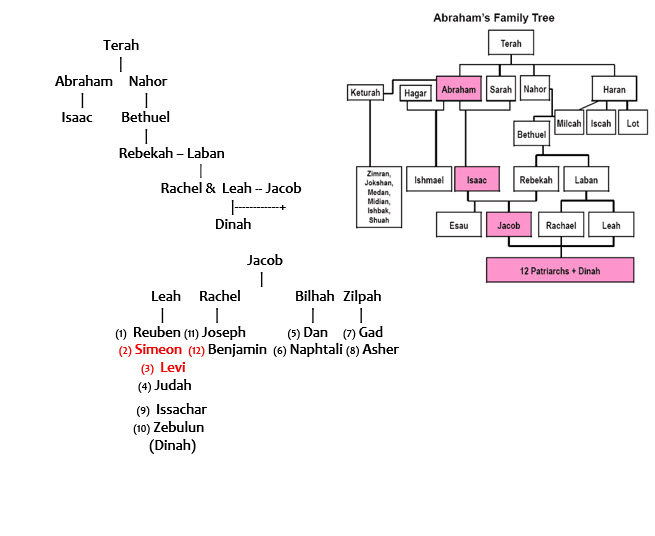
Genesis 34:1-2 (KJV), “And Dinah the daughter of Leah, which she bare unto Jacob, went out to see the daughters of the land. 2 And when Shechem the son of Hamor the Hivite, prince of the country, saw her, he took her, and lay with her, and defiled her.”
Should Shechem be forgiven for violating Dinah while not married to her?
Genesis 34:11-12 (KJV), “11 And Shechem said unto her father and unto her brethren, Let me find grace in your eyes, and what ye shall say unto me I will give. 12 Ask me never so much dowry and gift, and I will give according as ye shall say unto me: but give me the damsel to wife.”
Based on all we know from the scriptures, I suspect all Dinah’s brothers had talked this over
It seems as though Simeon and Levi took advantage of the men of the city in deep pain
Genesis 34:25 (KJV), “And it came to pass on the third day, when they were sore, that two of the sons of Jacob, Simeon and Levi, Dinah’s brethren, took each man his sword, and came upon the city boldly, and slew all the males.”
Though all of the brothers participated in the plundering of the city, it appears that Jacob knew that only Simeon and Levi were the murderers
Genesis 34:30 (KJV), “And Jacob said to Simeon and Levi, Ye have troubled me to make me to stink among the inhabitants of the land, among the Canaanites and the Perizzites: and I being few in number, they shall gather themselves together against me, and slay me; and I shall be destroyed, I and my house.”
Isaiah 25
Isaiah has read the scriptures that had preceded him
Isaiah 25:1 (KJV), “O Lord, thou art my God; I will exalt thee, I will praise thy name; for thou hast done wonderful things; thy counsels of old are faithfulness and truth.”
As Isaiah 24 was a prophecy from God to Isaiah on the ultimate destruction of the earth, this chapter reflects Isaiah’s praising our God for His faithfulness
The saved
Isaiah 25:3-4 (KJV), “3 Therefore shall the strong people glorify thee, the city of the terrible nations shall fear thee. 4 For thou hast been a strength to the poor, a strength to the needy in his distress, a refuge from the storm, a shadow from the heat, when the blast of the terrible ones is as a storm against the wall.”
Isaiah 25:6 (KJV), “And in this mountain shall the Lord of hosts make unto all people a feast of fat things, a feast of wines on the lees, of fat things full of marrow, of wines on the lees well refined.”
Isaiah 25:9 (KJV), “And it shall be said in that day, Lo, this is our God; we have waited for him, and he will save us: this is the Lord; we have waited for him, we will be glad and rejoice in his salvation.”
The unsaved
Isaiah 25:5 (KJV), “Thou shalt bring down the noise of strangers, as the heat in a dry place; even the heat with the shadow of a cloud: the branch of the terrible ones shall be brought low.”
Isaiah 25:7-8 (KJV), “7 And he will destroy in this mountain the face of the covering cast over all people, and the vail that is spread over all nations. 8 He will swallow up death in victory; and the Lord God will wipe away tears from off all faces; and the rebuke of his people shall he take away from off all the earth: for the Lord hath spoken it.”
Isaiah 25:10-12 (KJV), “10 For in this mountain shall the hand of the Lord rest, and Moab shall be trodden down under him, even as straw is trodden down for the dunghill. 11 And he shall spread forth his hands in the midst of them, as he that swimmeth spreadeth forth his hands to swim: and he shall bring down their pride together with the spoils of their hands. 12 And the fortress of the high fort of thy walls shall he bring down, lay low, and bring to the ground, even to the dust.”
Psalms 21
The joy of our salvation is reflected to that of the kings of old
Psalm 21:1-2 (KJV), “The king shall joy in thy strength, O Lord; and in thy salvation how greatly shall he rejoice! 2 Thou hast given him his heart’s desire, and hast not withholden the request of his lips. Selah.”
Selah
Brown-Driver-Briggs – verb; lift up (voices in praise).
The praises of Jesus
Psalm 21:5-7 (KJV), “5 His glory is great in thy salvation: honour and majesty hast thou laid upon him. 6 For thou hast made him most blessed forever: thou hast made him exceeding glad with thy countenance. 7 For the king trusteth in the Lord, and through the mercy of the most High he shall not be moved.”
Psalm 21:13 (KJV), “Be thou exalted, Lord, in thine own strength: so will we sing and praise thy power.”
Proverbs 6
Dangerous promises – surety
Proverbs 6:1 (KJV), “My son, if thou be surety for thy friend, if thou hast stricken thy hand with a stranger.”
Surety, friend, & stranger
- There are three key words in this initial verse; surety, friend, and stranger
- [you become] Surety
- Strong’s Concordance (6148) – arab: to take on pledge, give in pledge, exchange.
- Look at the original intent of the word surety
- 1828 Webster’s Dictionary 5. In law, one that is bound with and for another; one who enters into a bond or recognizance to answer for another’s appearance in court, or for his payment of a debt or for the performance of some act, and who, in case of the principal debtor’s failure, is compellable to pay the debt or damages; a bondsman; a bail.
- [for your] Friend
- Strong’s Concordance (7453) – rea: friend, companion, fellow. Brown-Driver-Briggs – 2. in weaker sense, fellow, fellow-citizen, even another person, with whom one stands in reciprocal relations.
- [for a] Stranger
- Strong’s Concordance (2114) – zuwr: another. Brown-Driver-Briggs – a. to the family, of another household.
- When you place yourself in this position, you are fully and legally taking on the entire responsibility [trapped] for someone outside of your earthly family
Proverbs 6:2 (KJV), “Thou art snared with the words of thy mouth, thou art taken with the words of thy mouth.”
Snared
Strong’s Concordance (3369) – yaqosh: to lay a bait or lure.
1828 Webster’s Dictionary SNA’RED, participle passive Entangled; unexpectedly involved in difficulty.
Why would Solomon use such a hard word as ‘trapped’?
He then proceeds to advice to do whatever it takes to get out of it
Proverbs 6:3-5 (KJV), “3 Do this now, my son, and deliver thyself, when thou art come into the hand of thy friend; go, humble thyself, and make sure thy friend. 4 Give not sleep to thine eyes, nor slumber to thine eyelids. 5 Deliver thyself as a roe from the hand of the hunter, and as a bird from the hand of the fowler.”
Do this now:
- and deliver thyself
- Strong’s Concordance (5337) – natsal: to strip, plunder, deliver oneself, be delivered, snatch away, deliver. Brown-Driver-Briggs – 1. reflexive tear oneself away, deliver oneself.
- Humble thyself [and Plead with]
- Strong’s Concordance (7292) – rahab: to act stormily, boisterously or arrogantly.
- Give not sleep to thine eyes, nor slumber to thine eyelids
- Do not sleep and be as arrogant and as boisterous as you can be, do not let up
- Same word as before; deliver thyself
- Get out of that trap
The Folly of Indolence – laziness
Proverbs 6:9-10 (KJV), “9 How long wilt thou sleep, O sluggard? when wilt thou arise out of thy sleep? 10 Yet a little sleep, a little slumber [sleep], a little folding of the hands to sleep.”
Sluggard
- 1828 Webster’s Dictionary A person habitually lazy, idle and inactive; a drone.
Picture a group of beggars travelling together and looking and plundering for whatever they can find
Proverbs 6:11 (KJV), “So shall thy poverty come as one that travelleth [travels in groups], and thy want [need] as an armed man [crooks].”
The six things the Lord hates
- Proverbs 6:16-19 (KJV), “16 These six things doth the Lord hate: yea, seven are an abomination unto him: 17 A proud look, a lying tongue, and hands that shed innocent blood, 18 An heart that deviseth wicked imaginations, feet that be swift in running to mischief, 19 A false witness that speaketh lies, and he that soweth discord among brethren.”
- Those things which God hates it is no thanks to us to hate in others, but we must hate them in ourselves
- To me, it is obvious what is meant by seven in which are an abomination to the Lord
- Proverbs 12:22 (KJV), “Lying lips are abomination to the Lord: but they that deal truly are his delight.”
- Of the six things the Lord hates, lying is repeated; a lying tongue and A false witness who speaks lies, which become the abomination to the Lord
As you go in life, it is important to keep the laws or ground work your earthly father and mother have given you
Proverbs 6:20 (KJV), “My son, keep thy father’s commandment, and forsake not the law of thy mother.”
Adultery
- What is adultery?
- The Hebrew word avah is sometimes translated as “lust,” sometimes as “craving” or “desire.” Another word is chamad [see Proverbs 6:25] which makes its most important appearance in the Ten Commandments, “You shall not covet.” It’s related to the idea of being desirable or pleasing. In the New Testament, the word for lust is epithumia [see Matthew 5:28]
- Proverbs 6:24-25 (KJV), “24 To keep thee from the evil woman, from the flattery of the tongue of a strange woman. 25 Lust [chamad] not after her beauty [adultery] in thine heart; neither let her take thee with her eyelids.”
- Brown-Driver-Briggs – a. in bad sense of inordinate, ungoverned, selfish desire.
- Exodus 20:14 (KJV), “Thou shalt not commit adultery.”
- Brown-Driver-Briggs – a. usually of man, always with wife of another.
- Matthew 5:27-29 (KJV), “27 Ye have heard that it was said by them of old time, Thou shalt not commit adultery: 28 But I say unto you, That whosoever looketh on a woman to lust [epithumia] after her hath committed adultery with her already in his heart. 29 And if thy right eye offend thee, pluck it out, and cast it from thee: for it is profitable for thee that one of thy members should perish, and not that thy whole body should be cast into hell.”
- Strong’s Concordance (1937) – epithumeó: desire, lust after. Usage: I long for, covet, lust after, set the heart upon.
- To lust after someone is not to look at but to desire; 1828 Webster’s 2. To have carnal desire; to desire eagerly the gratification of carnal appetite.
- Once you continue after your gratification of your carnal appetite
- Proverbs 6:26 (KJV), “For by means of a whorish woman a man is brought to a piece of bread: and the adultress will hunt for the precious life.”
- In keeping with what Jesus told the crowd in Matthew 5, He was not redefining adultery
- Matthew 5:17 (KJV), “Think not that I am come to destroy the law, or the prophets: I am not come to destroy, but to fulfil.”
He came to explain it

 Grow in the Word of the Lord