
THE THOUGHT FOR THE DAY
We are to trust only in God with true reverential fear
“The fear of man bringeth a snare: but whoso putteth his trust in the Lord shall be safe.”
Proverbs 29:25 (KJV)
Genesis 10
Only the sons of Noah repopulated the entire earth
Genesis 10:1 (KJV), “Now these are the generations of the sons of Noah, Shem, Ham, and Japheth: and unto them were sons born after the flood.”
Genesis 9:1 (KJV), “And God blessed Noah and his sons, and said unto them, Be fruitful, and multiply, and replenish the earth.”
Genesis 10:32 (KJV), “These are the families of the sons of Noah, after their generations, in their nations: and by these were the nations divided in the earth after the flood.”

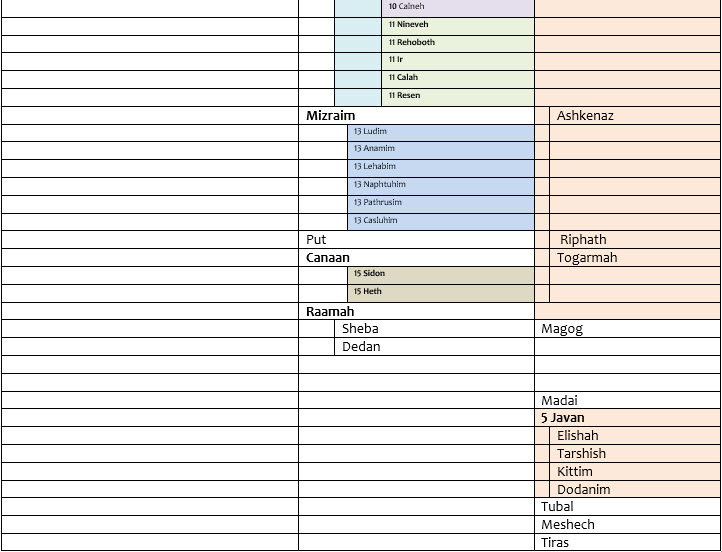
Align colors below to their color in the above tables for cross references
Genesis 10:5 (KJV), “By these were the isles of the Gentiles divided in their lands; every one after his tongue, after their families, in their nations.”
Genesis 10:6 (KJV), “And the sons of Ham; Cush, and Mizraim, and Phut, and Canaan.”
Genesis 10:7 (KJV), “And the sons of Cush; Seba, and Havilah, and Sabtah, and Raamah, and Sabtechah: and the sons of Raamah; Sheba, and Dedan.”
Genesis 10:8-9 (KJV), “8 And Cush begat Nimrod: he began to be a mighty one in the earth. 9 He was a mighty hunter before the Lord: wherefore it is said, Even as Nimrod the mighty hunter before the Lord.”
Genesis 10:10 (KJV), “And the beginning of his kingdom was Babel, and Erech, and Accad, and Calneh, in the land of Shinar.”
Genesis 10:11 (KJV), “Out of that land went forth Asshur, and builded Nineveh, and the city Rehoboth, and Calah.”
Genesis 10:13-14 (KJV), “13 And Mizraim begat Ludim, and Anamim, and Lehabim, and Naphtuhim, 14 And Pathrusim, and Casluhim, (out of whom came Philistim,) and Caphtorim.”
Genesis 10:15-20 (KJV), “15 And Canaan begat Sidon his first born, and Heth, 16 And the Jebusite, and the Amorite, and the Girgasite, 17 And the Hivite, and the Arkite, and the Sinite, 18 And the Arvadite, and the Zemarite, and the Hamathite: and afterward were the families of the Canaanites spread abroad. 19 And the border of the Canaanites was from Sidon, as thou comest to Gerar, unto Gaza; as thou goest, unto Sodom, and Gomorrah, and Admah, and Zeboim, even unto Lasha. 20 These are the sons of Ham, after their families, after their tongues, in their countries, and in their nations.”
Genesis 10:21 (KJV), “Unto Shem also, the father of all the children of Eber, the brother of Japheth the elder, even to him were children born.”
Genesis 10:23 (KJV), “And the children of Aram; Uz, and Hul, and Gether, and Mash.”
Genesis 10:24-26 (KJV), “24 And Arphaxad begat Salah; and Salah begat Eber. 25 And unto Eber were born two sons: the name of one was Peleg; for in his days was the earth divided; and his brother’s name was Joktan. 26 And Joktan begat Almodad, and Sheleph, and Hazarmaveth, and Jerah.”
Countries around the world were populated by the following lineage of Noah
1] The sons of Japheth: He was the father of the Indo-European peoples, those stretching from India to the shores of Western Europe. They are each linked by linguistic similarities that often seem invisible to the layman but are much more obvious to the linguist.
Gomer: From this son of Japheth came the Germanic peoples, from whom came most of the original peoples of Western Europe. These include the original French, Spanish, and Celtic settlers.
Magog…Tubal, Meshech: These settled in the far north of Europe and became the Russian peoples.
Madai: From this son of Japheth came the ancient Medes and they populated what are now Iran and Iraq. The peoples of India also came from this branch of Japheth’s family.
Javan: From this son of Japheth came the ancient Greeks, whose sea-faring ways are described in Genesis 10:5.
Togarmah: From this son of Gomer came the Armenians.
The sons of Javan were: Geographic names that spring from these names in this chapter abound. Linguists have no trouble seeing the connection between Kittim and Cyprus, Rodanim and Rhodes, Gomer and Germany, Meschech and Moscow, Tubal and Tobolsk.
Ham: The descendants of Ham are the peoples who populated Africa and the Far East.
Cush: Apparently, this family divided into two branches early. Some founded Babylon (notably, Nimrod) and others founded Ethiopia.
Mizraim: This is another way the Bible refers to Egypt. Put refers to Libya, the region of North Africa west of Egypt. Canaan refers to the peoples who originally settled the land we today think of as Israel and its surrounding regions.
Canaan begot Sidon: The family of Sidon, the son of Canaan, went north and is related to the Hittites and Lebanese.
And the Sinite: Many people believe the Oriental peoples descended from the Sinites.
Shem – Arphaxad was the ancestor of Abram and the Hebrews.
All these were the sons of Joktan: The names after the son of Joktan (son of Eber, son of Salah, son of Arphaxad) are all associated with various Arabic peoples.
Nahum 3
The casualties of Nineveh
Nahum 3:2-4 (KJV), “2 The noise of a whip, and the noise of the rattling of the wheels, and of the pransing horses, and of the jumping chariots. 3 The horseman lifteth up both the bright sword and the glittering spear: and there is a multitude of slain, and a great number of carcases; and there is none end of their corpses; they stumble upon their corpses: 4 Because of the multitude of the whoredoms of the wellfavoured harlot, the mistress of witchcrafts, that selleth nations through her whoredoms, and families through her witchcrafts.”
Nahum telling those of Nineveh the Lord’s plans
Nahum 3:5-7 (KJV), “5 Behold, I am against thee, saith the Lord of hosts; and I will discover thy skirts upon thy face, and I will shew the nations thy nakedness, and the kingdoms thy shame. 6 And I will cast abominable filth upon thee, and make thee vile, and will set thee as a gazingstock. 7 And it shall come to pass, that all they that look upon thee shall flee from thee, and say, Nineveh is laid waste: who will bemoan her? whence shall I seek comforters for thee?”
Some of Nineveh’s atrocities
Nahum 3:9-10 (KJV), “9 Ethiopia and Egypt were her strength, and it was infinite; Put and Lubim were thy helpers. 10 Yet was she carried away, she went into captivity: her young children also were dashed in pieces at the top of all the streets: and they cast lots for her honourable men, and all her great men were bound in chains.”
The outcome
Nahum 3:19 (KJV), “There is no healing of thy bruise; thy wound is grievous: all that hear the bruit of thee shall clap the hands over thee: for upon whom hath not thy wickedness passed continually?”
2 Corinthians 8
What does Paul mean by ‘Jesus being rich’?
2 Corinthians 8:9 (KJV), “For ye know the grace of our Lord Jesus Christ, that, though he was rich, yet for your sakes he became poor, that ye through his poverty might be rich.”
Though He was rich
Strong’s Concordance (4145) – plousios: wealthy.
Though the [2] RGW comes from the word ‘wealthy’, how is it used in this context?
Thayer’s Greek Lexicon – b. metaphorically and universally, abounding, abundantly supplied. He formerly abounded in the riches of a heavenly condition, by assuming human nature he entered into a state of (earthly) poverty.
He became poor
Strong’s Concordance (4433) – ptócheuó: to be a beggar, be destitute.
Cognate: 4433 ptōxeúō – to become utterly poor (destitute); hence, to become extremely vulnerable (“helpless”). (“become destitute”) is only used in 2 Cor 8:9 of the physical humiliations Christ voluntarily experienced in His mission here on earth.
Thayer’s Greek Lexicon – to be a beggar, to beg; to be poor.
Might be rich
Strong’s Concordance (4147) – plouteó: to be rich. Note how closely related the two words are in the Strong’s;
Though He was rich (4145); Might be rich (4147).
Again, though the RGW comes from the word ‘rich’, how is it used in this context?
Thayer’s Greek Lexicon – b. metaphorically, to be richly supplied; obtained the eternal spiritual possessions.
Paul tells the Corinthians of the Macedonians and commends their charity. He tells them they were but in a low condition, and themselves in distress, yet they contributed to the relief of others
2 Corinthians 8:1-2 (KJV), “Moreover, brethren, we do you to wit of the grace of God bestowed on the churches of Macedonia; 2 How that in a great trial of affliction the abundance of their joy and their deep poverty abounded unto the riches of their liberality.”
The moment you accept Christ as your Lord and Savior, you begin a journey of faith, hope, and love of all. This is something that is not just for the moment or for a designated period of time, but continuously through your journey on earth.
2 Corinthians 8:10-12 (KJV), “10 And herein I give my advice: for this is expedient for you, who have begun before, not only to do, but also to be forward a year ago. 11 Now therefore perform the doing of it; that as there was a readiness to will, so there may be a performance also out of that which ye have. 12 For if there be first a willing mind, it is accepted according to that a man hath, and not according to that he hath not.”
We are to continuously give abundantly and equally to others
2 Corinthians 8:13-15 (KJV), “13 For I mean not that other men be eased, and ye burdened: 14 But by an equality, that now at this time your abundance may be a supply for their want, that their abundance also may be a supply for your want: that there may be equality: 15 As it is written, He that had gathered much had nothing over; and he that had gathered little had no lack.”
Exodus 16:18 (KJV), “And when they did mete it with an omer, he that gathered much had nothing over, and he that gathered little had no lack; they gathered every man according to his eating.”
We are always to show love to all, believers and non-believers, so they can witness the joy of the Lord
2 Corinthians 8:24 (KJV), “Wherefore shew ye to them, and before the churches, the proof of your love, and of our boasting on your behalf.”
Proverbs 29
It is our responsibility to teach our children righteously
Proverbs 29:15 (KJV), “The rod and reproof give wisdom: but a child left to himself bringeth his mother to shame.”
Proverbs 29:17 (KJV), “Correct thy son, and he shall give thee rest; yea, he shall give delight unto thy soul.”
We are to trust only in God with true reverential fear
Proverbs 29:25 (KJV), “The fear of man bringeth a snare: but whoso putteth his trust in the Lord shall be safe.”
Romans 9
In God’s creation of mankind, He chooses who will become His children. He has mercy on whom He wills
Romans 9:18-21 (KJV), “18 Therefore hath he mercy on whom he will have mercy, and whom he will he hardeneth. 19 Thou wilt say then unto me, Why doth he yet find fault? For who hath resisted his will? 20 Nay but, O man, who art thou that repliest against God? Shall the thing formed say to him that formed it, Why hast thou made me thus? 21 Hath not the potter power over the clay, of the same lump to make one vessel unto honour, and another unto dishonour?”
Though God chose the Jews, Israel, as His chosen, it does not mean that ‘His chosen’ will be saved
Romans 9:27-28 (KJV), “27 Esaias also crieth concerning Israel, Though the number of the children of Israel be as the sand of the sea, a remnant shall be saved: 28 For he will finish the work, and cut it short in righteousness: because a short work will the Lord make upon the earth.”
Salvation is open to Jews and Gentiles
Romans 9:30-32 (KJV), “30 What shall we say then? That the Gentiles, which followed not after righteousness, have attained to righteousness, even the righteousness which is of faith. 31 But Israel, which followed after the law of righteousness, hath not attained to the law of righteousness. 32 Wherefore? Because they sought it not by faith, but as it were by the works of the law. For they stumbled at that stumblingstone.”
[1] David Guzik
[2] Root Greek Word

 Grow in the Word of the Lord