
Strength through leadership
“12 For when for the time ye ought to be teachers, ye have need that one teach you again which be the first principles of the oracles of God; and are become such as have need of milk, and not of strong meat. 13 For every one that useth milk is unskilful in the word of righteousness: for he is a babe. 14 But strong meat belongeth to them that are of full age, even those who by reason of use have their senses exercised to discern both good and evil.”
Hebrews 5:12 (KJV)
When a new believer is chosen by God to share in His inheritance, the age old question is, ‘where to begin?’ Where do you tell this new child of God to begin reading?
We are all very blessed and fortunate that God gave us His personal instruction manual for life. There is no situation that we could ever encounter in our lifetime that is not instructed to us in His written Word.
The written scriptures are the result of perfectly inspired (2 Timothy 3:16) words God had ‘breathed’ to His chosen and qualified amanuensis. Now that we have God’s written instruction manual, what is the best way to go about interpreting His Word in a logical and comprehensible way?
2 Timothy 3:16 (KJV), “All scripture is given by inspiration of God, and is profitable for doctrine, for reproof, for correction, for instruction in righteousness.”
I am going to present to you what I believe to be a guiding principle to help you start, or improve, your relationship with God. To assist you in the process of cementing your foundation and life long marriage to our Bridegroom (Isaiah 54:5).
Isaiah 54:5 (KJV), “For thy Maker is thine [1] husband; the Lord of hosts is his name; and thy Redeemer the Holy One of Israel; The God of the whole earth shall he be called.”
What has God provided for us
It is important to understand that no one book of God’s scriptures is more important than another. There are also many different ways in which God can guide us to reading His Word. That is to say that one person’s journey through His Word is no better than any others journey. What is important is to ask God.
Having said this, I believe it is important to build a solid foundation for understanding God’s Word to fully benefit yourself to His guidance and to fall immersely (immerse and immense) in love with Him.
A little background on the Holy Scriptures
Languages
It is imperative for you to understand that the holy scriptures were not written in English. Why do I bring up an obvious point? For the vast majority of Americans, that is the only way we have to read and comprehend God’s Word. The Old Testament is written in Hebrew and Aramaic and The New Testament was written in a form of Koine Greek, which was the common language of the Eastern Mediterranean.
Changing definitions
Through the years, times, cultures, and veering away from God’s established traditions, the meaning of words have greatly changed. Just one obvious word that has greatly changed is marriage.
The Webster’s 1828 Dictionary – The act of uniting a man and woman for life; wedlock; the legal union of a man and woman for life.
Today – In modern society, marriage is generally viewed as a voluntary union between two individuals based on love, respect, and mutual commitment. It is a social institution with diverse genders, races, and sexual orientations.
1 Belief
Jesus is God
[coming soon]
2 Timothy 3:16 (KJV), “All scripture is given by inspiration of God, and is profitable for doctrine, for reproof, for correction, for instruction in righteousness.”
What does this verse from 1 Timothy mean to you? Let us break this down.
‘All’
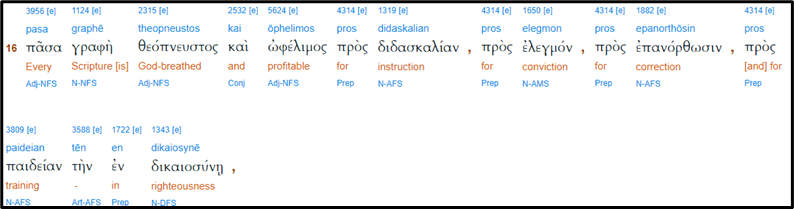

Strong’s Concordance (3956) – pas: all, every. Thayer’s Greek Lexicon – c. the whole.
‘Scripture’
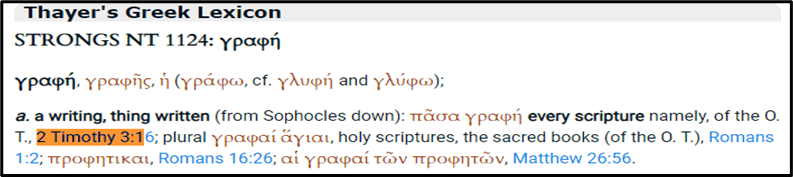
Strong’s Concordance (1124) – graphé: a writing, scripture. Thayer’s Greek Lexicon – a. writing, thing written (from Sophocles down): πᾶσα γραφή every scripture namely, of the O. T.
‘By inspiration of God’
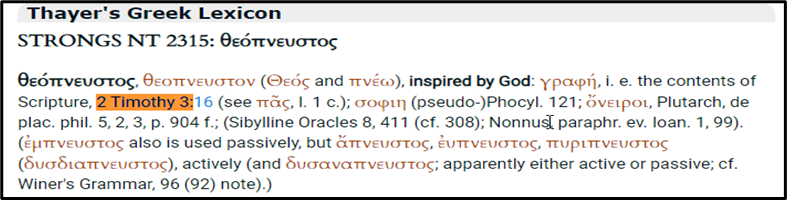
Strong’s Concordance – theopneustos: God-breathed, i.e. inspired by God. Thayer’s Greek Lexicon – inspired by God: γραφή, i. e. the contents of Scripture, 2 Timothy 3:16.
So, here we have, “The whole written every scripture is inspired by God (God-breathed).”
As believers in the Lord Jesus Christ as our Savior, we must believe that every written of canonized scripture was God-breathed to every prophet and/or scribe of the Holy Scriptures. This is an unwavering faith that every jot and title is an accurate representation of historical scripture.
2 Different meanings
The Old Testament is written in Hebrew and Aramaic. The majority of the text is written in Hebrew, with Aramaic used in a few chapters in Daniel and Ezra, one verse in Jeremiah, and one phrase in Genesis. Biblical Hebrew, also called Classical Hebrew, is an archaic form of the Hebrew language, a language in the Canaanite branch of Semitic languages spoken by the Israelites in the area known as the Land of Israel, roughly west of the Jordan River and east of the Mediterranean Sea.
The New Testament was written in a form of Koine Greek, which was the common language of the Eastern Mediterranean from the conquests of Alexander the Great (335–323 BC) until the evolution of Byzantine Greek (c. 600). Greek is an independent branch of the Indo-European family of languages, native to Greece, Cyprus, Italy, southern Albania, and other regions of the Balkans, the Black Sea coast, Asia Minor, and the Eastern Mediterranean.
During Jesus’ time on earth, Aramaic was the language spoken in Israel. However, the gospels were written in Greek. Therefore, with only a few exceptions (Mark 5:41, Mark 7:34, and Matthew 27:46), the New Testament does not contain the exact words of Jesus—it contains an accurate Greek translation of them.
This guide to a profitable journey through the Holy Scriptures is not an attempt to make anyone a biblical scholar but to provide to you an understanding of certain principles you need to understand when reading God’s Word.
There are many words used in both Testaments that can have more than one meaning and, depending on the context of that verse, chapter, or book, the actual definition of the word could vary.
A source that is commonly used to find the definition of the words in the scriptures is the Strong’s Exhaustive Concordance of the Bible. The Strong’s Concordance was first published in 1890 and revised editions are still in print today. Professor Strong had over a hundred people working on this project who diligently listed every occurrence of every word in the KJV. The first edition of Daniel Webster’s Dictionary (1828) was also a result of defining the words in the KJV.
As mentioned earlier, it is also important to understand the context of these words. A trio of eminent Old Testament scholars, Francis Brown, S. Driver, and Charles Briggs, spent over twenty years researching, writing, and preparing this lexicon. Since it first appeared in the early part of the twentieth century, BDB has been considered the finest and most comprehensive Hebrew lexicon available to the English-speaking student. Based upon the classic work of Wilhelm Gesenius, the “father of modern. Hebrew lexicography,” BDB gives not only dictionary definitions for each word, but relates each word to its Old Testament usage and categorizes its nuances of meaning.
Here are some examples of words that have more than one meaning. The term “angel,” in both the Old and New Testaments can have multiple word meanings.
Angel
1. Strong’s Concordance (4397) – malak: a messenger.
A . Brown-Driver-Briggs – 1. messenger, a. one sent with a message.
Deuteronomy 2:26 (KJV), “And I sent messengers out of the wilderness of Kedemoth unto Sihon king of Heshbon with words of peace, saying.”
B. Brown-Driver-Briggs – 2. angel, as messenger of God.
1 Samuel 29:9 (KJV), “And Achish answered and said to David, I know that thou art good in my sight, as an angel of God: notwithstanding the princes of the Philistines have said, He shall not go up with us to the battle.”
C. Brown-Driver-Briggs – 3. the theophanic angel.
Judges 13:3 (KJV), “And the angel of the Lord appeared unto the woman, and said unto her, Behold now, thou art barren, and bearest not: but thou shalt conceive, and bear a son.”
Peculiar people
1 Peter 2:9 (KJV), “But ye are a chosen generation, a royal priesthood, an holy nation, a peculiar people; that ye should shew forth the praises of him who hath called you out of darkness into his marvellous light”.
The Webster’s 1828 Dictionary – 1. Appropriate; belonging to a person and to him only.
The Webster’s today – 1. strange or unusual; odd.
Understanding Proverbs
The book of Proverbs was primarily written, with inspiration from God, by Solomon. Solomon was not only wise in his days but God promised Solomon that he would be the wisest person to ever exist.
[coming soon]
[1] God’s passionate love for Israel is reflected in the Hebrew word Ish (EESH), meaning “husband.” When it is applied to God in the Hebrew Scriptures, it symbolizes the ideal relationship between God and Israel. God is the perfect husband — loving, forgiving, and faithful, providing for and protecting His people.
 Grow in the Word of the Lord