
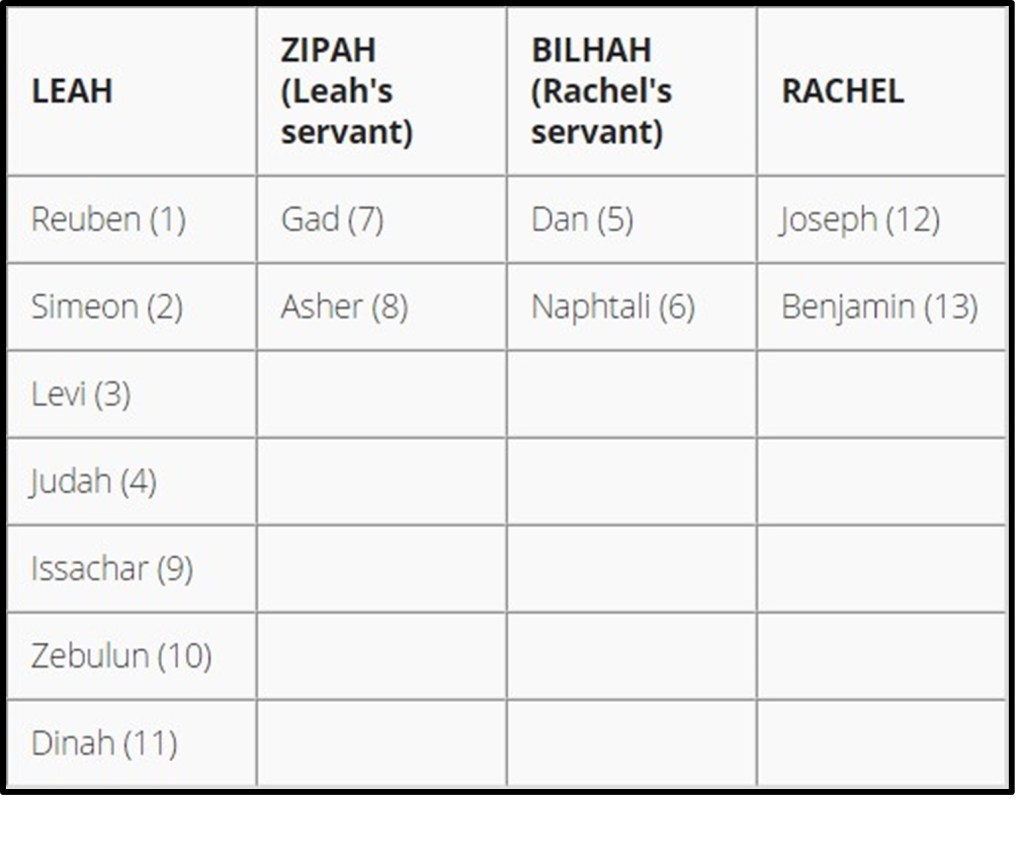
Appendix A The sons (Tribes) of Israel
Appendix B Using Jacob and Israel interchangeably [Return]
Bar-Ilan University
Parashat Vayehi 5773/December 29, 2012
Parashat Hashavua Study Center
Lectures on the weekly Torah reading by the faculty of Bar-Ilan University in Ramat Gan, Israel. A project of the Faculty of Jewish Studies, Paul and Helene Shulman Basic Jewish Studies Center, and the Office of the Campus Rabbi. Published on the Internet under the sponsorship of Bar-Ilan University’s International Center for Jewish Identity. Prepared for Internet Publication by the Computer Center Staff at Bar-Ilan University.
948
Raphael Yachin*
Switching Between the Names Jacob and Israel
Well-known exegetes and Bible scholars have dealt with the way Scripture uses the name Jacob even after the Lord’s explicit promise, “You shall be called Jacob no more, but Israel shall be your name” (Gen. 35:10) and the statement, “Thus He named him Israel.” Note that the man (angel) with whom Jacob wrestled at the ford of the Yabok had changed his name to Israel earlier (Gen. 32:29), but this name change was made under special circumstances and therefore perhaps should not be viewed as binding until it received divine confirmation. In any event, Jacob is the only instance of a person being given a new name that does not cancel all use of the former, original name. Let us examine the reason for this.
Several commentators have tried to provide a rationale for the alternation of names used for Jacob. Moshe Tzvi Segal, in Mesort u-Vikoret ha-Mikra,[1] devotes an entire chapter to this question, taking issue with the proponents of the Documentary Hypothesis and ultimately rejecting their approach. He also rejects the explanations of such commentators as Abraham Geiger,[2] Umberto Cassuto[3] and Benno Jacob who associated the use of particular names with specific content. Segal ultimately concludes that “one should not look for homiletic explanations and hidden reasons…for switching between the two names because [of] various Scriptural passages which contradict such assumptions.”50
Rabbi Samson Raphael Hirsch takes up this challenge and grapples with it throughout the Joseph narrative. He holds that the alternating names reflect Jacob’s different emotional states in the light of what was transpiring. The name Jacob, he maintains, connects with the stooped, downcast man whereas the name Israel connotes hope and reinvigoration (see his commentary on 43:6):
Ever since the loss of Joseph, the name Jacob is always used. For Jacob denotes the downcast man, the sense of dependence and decline, as a person who “limps” after events, a person who is dragged along by events rather than marching in the lead.
The name Israel shows us the points of light in his life. On the verse, “Now Israel loved Joseph best of all his sons” (Gen. 37:3), Rabbi Samson Raphael Hirsch notes: “Israel—not Jacob—for he viewed him as his chosen son, because he was the son of his old age and in him he saw himself repeated and coming again to life; in him he saw the heir of all his spiritual wealth.”[4]
Even though this approach explains a considerable number of alternations of Jacob/Israel, it does not account for all such instances. Here we suggest using statistical significance, commonly applied in textual analysis. Examining the distribution of appearances of each name, we find that in connection with Joseph the name “Jacob” is mentioned only 8 times, as opposed to 17 for “Israel”, while in other contexts we find almost the opposite: “Israel” appears only 5 times, whereas “Jacob” appears 37 times.[5] Thus there appears to be a connection between the use of the name “Israel” and the appearance of Joseph on the stage. Insofar as “Israel” is known to be the national nomenclature for Jacob’s descendants, this combination of names reinforces the notion of Joseph as chosen to realize the national destiny of “Israel”. As we shall see below, switching between the names helps explain several important issues in the narrative about Joseph and his brothers.
Even though the cause of the brothers’ hatred of Joseph – it being in the context of Jacob’s preference of Joseph – is explicitly stated in Scripture, it does not suffice to account for the destructive intensity of this hatred. Let us try to further fathom the nature of the hatred and competitiveness among Joseph’s brothers. The ornamented tunic in which Jacob dressed Joseph is symbolic of sovereignty,[6] and apparently attests that Joseph was not only destined to be Jacob’s spiritual heir and the one to carry on the dynasty of the Patriarchs, but also to be heir of his material wealth. Moreover, the verses, “This, then, is the line of Jacob: Joseph…” (Gen. 37:2) and “Now Israel loved Joseph best of all his sons” (Gen. 37:3) stress the element of continuity evident in Joseph, in contrast to rejection of the other brothers who were not found worthy of that same inheritance. The midrash further supports such a perception: “Joseph was worthy that the twelve tribes should issue from him…but his lust came out from between his fingernails” (Sotah 36b).[7]
Seeing that Joseph was destined as the son to carry on the line of “Israel” and be the heir of the patriarchs, the other sons might well have feared that they would follow in the path of the other rejected branches of the family—Ishmael and Esau, who became the heads of clans of other, separate nations. Abraham had been told, “I will make you a father of a multitude of nations” (Gen. 17:5), and from him had issued Isaac, Ishmael, and the sons of his concubines. Rivkah had been told, “Two nations are in your womb, two separate peoples shall issue from your body” (Gen. 20:23), and from her came Esau and Jacob. Jacob had been given a similar promise: “A nation, yea an assembly of nations, shall descend from you” (Gen. 35:11), which might be taken as alluding to one important nation and “an assembly of nations” which is separate and distinct from the one chosen as successor. Moreover, the promise of progeny and of the land was only heard by Joseph (Gen. 48:3) without his sharing this information with the rest of his brothers. Thus, Joseph’s brothers discerned several signs that appeared to confirm their feeling of being destined to be the rejected “assembly of nations.” Clearly this was especially hurtful to the sons of Leah, who herself had suffered Jacob’s discrimination against her due to his love for Rachel. This perception throws a different light on the ties between the concubines’ sons and Joseph—”a helper to the sons of his father’s wives Bilhah and Zilpah” (Gen. 37:2); they were willing to accept Joseph’s superiority in view of their lower status.
Judah is an exceptional figure in the Joseph narrative, in which he emerges as a resourceful leader in times of despair. In the verses describing Judah’s willingness to take responsibility for Benjamin and to return to Egypt to buy more grain, the name “Israel” surfaces again several times.[8] This unusual occurrence can be explained in terms of Jacob being encouraged by Judah’s leadership and therefore trusting him and seeing in him a substitute for the loss of his beloved son Joseph, whom he had destined to assume the role of leadership.[9]
Can these observations account for Jacob’s great suffering over Joseph’s disappearance? Was Jacob punished by twenty-two years of misery and mourning because he had erred in determining the destiny of the tribes and had seen them as rejected branches? Since Scripture does not reveal why “few and hard have been the years of my [Jacob’s] life” (Gen. 47:9), as Jacob described his life to Pharaoh, we shall try to extract some hints from Jacob’s blessings to his sons.
Only after concluding all the blessings does Jacob make the important declaration, containing an explicit promise: “All these were the tribes of Israel, twelve in number, and this is what their father said to them as he bade them farewell” (Gen. 49:28), unlike the previous reference to his sons: “Now the sons of Jacob were twelve in number” (Gen. 35:22). This summation, after his addressing each of the tribes, signifies that there will no longer be sons who are rejected, but that they will comprise the people of Israel together. In Scripture the expression, “what [he] said,” can mean a promise, as in “who said to me and promised me on oath” (Gen. 24:7); “to the end that He may establish you this day as His people…as He said to you and as He swore to your fathers” (Deut. 29:12); “The Lord had given Solomon wisdom, as He had said to him” (I Kings 5:26).
If the above declaration of Jacob’s is viewed as a promise to all the tribes that they will be the “children of Israel,” – that is, the Jewish people – then this brings to an end the era of suspiciousness and doubt that so sorely gnawed away at the foundation of trust in Jacob’s family. We speak not only of the suspicions of the brothers towards Joseph, but also of Joseph’s silence throughout the years that he was serving in a lofty position in Egypt while his father, back home in Canaan, was grieving over the “death” of his son.[10] This is a fitting way to end the book of Genesis, bringing the story of Jacob and his sons to a successful conclusion. In the end all his sons, both those whom he blessed as well as those whom he rebuked, were included in the nation of Israel and no tribe from among his sons was rejected. Just as Joseph’s brothers understood that their hatred of him had been a tragic mistake and that all that had befallen them in Egypt was had been punishment for their treatment of Joseph, so too Jacob understood that his attitude towards Joseph’s brothers had been mistaken and that they were all worthy of being the “children of Israel,” part of the emergent Israelite nation.*
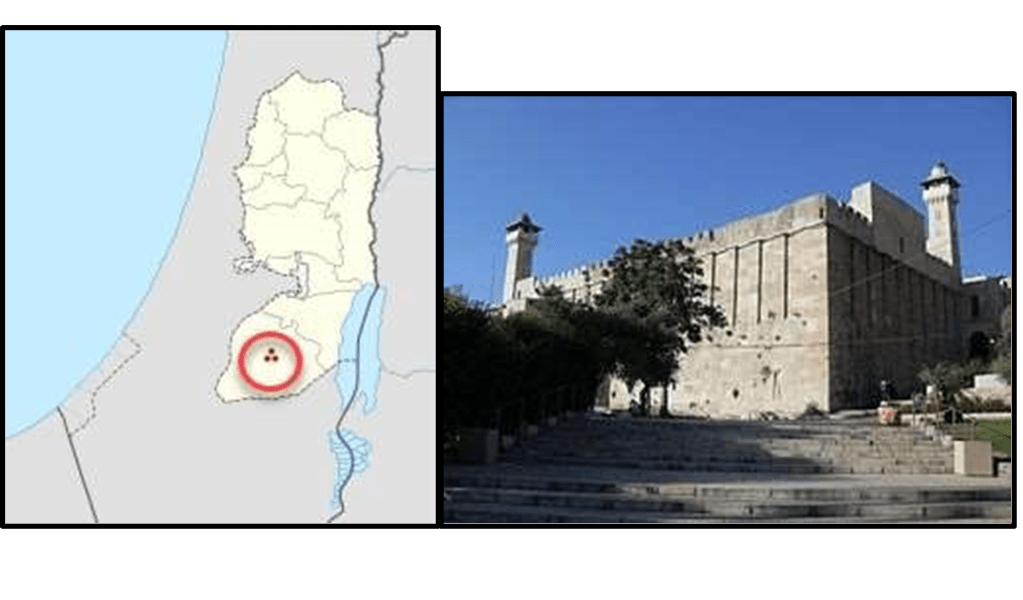
Appendix C Cave of the Patriarchs
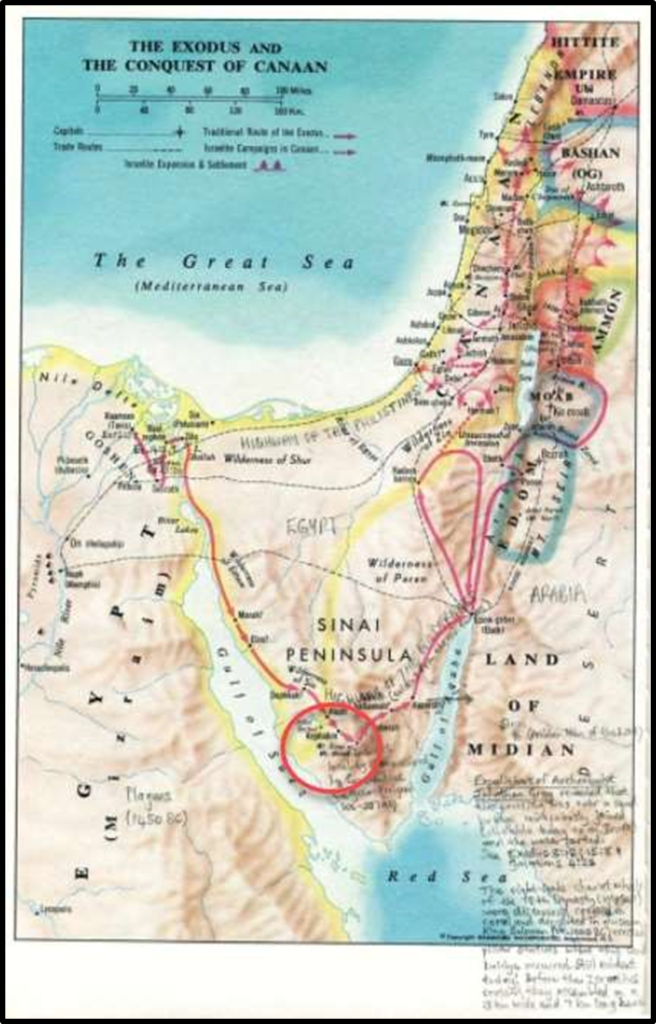
Appendix D Horeb or Mount Sinai
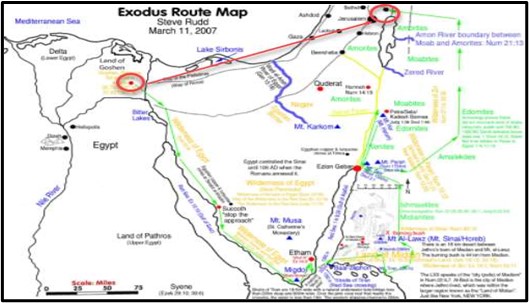
Appendix E Two different routes from Egypt to Canaan
Appendix F The Jews complain
You lead us into this trap.
God lead Moses and the Jews the long route and boxed them in at the Red Sea.
What shall we drink?
Moses brought hunger to the Jews.
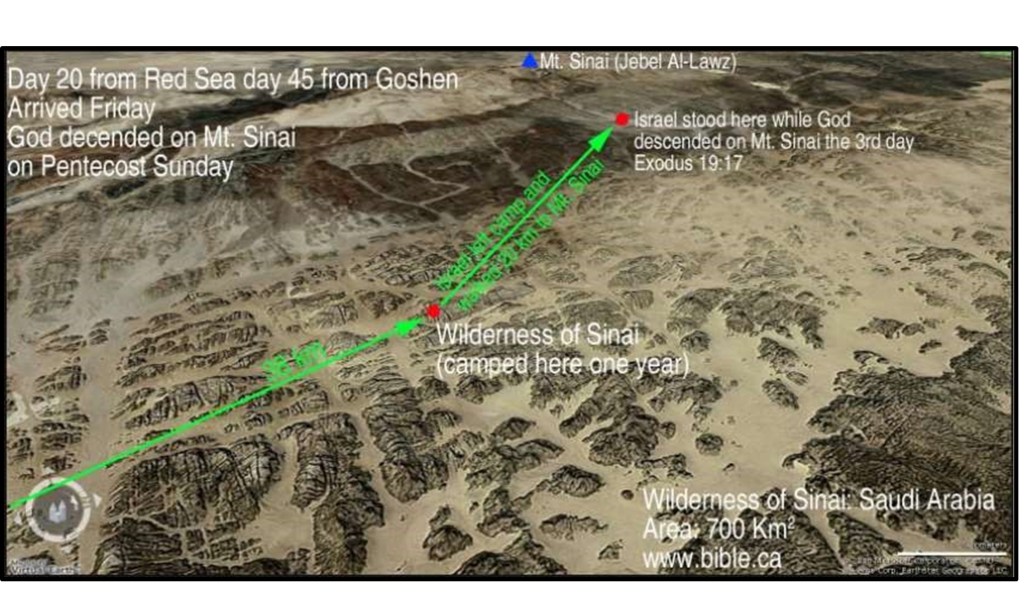
Appendix G the Wilderness of Sinai
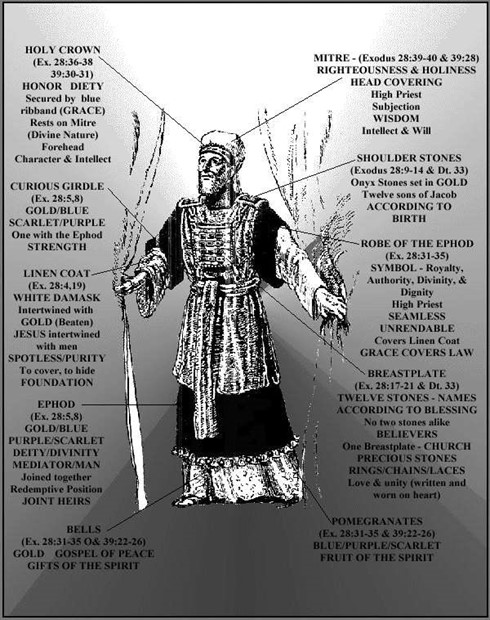
Appendix H Garments for the Priesthood
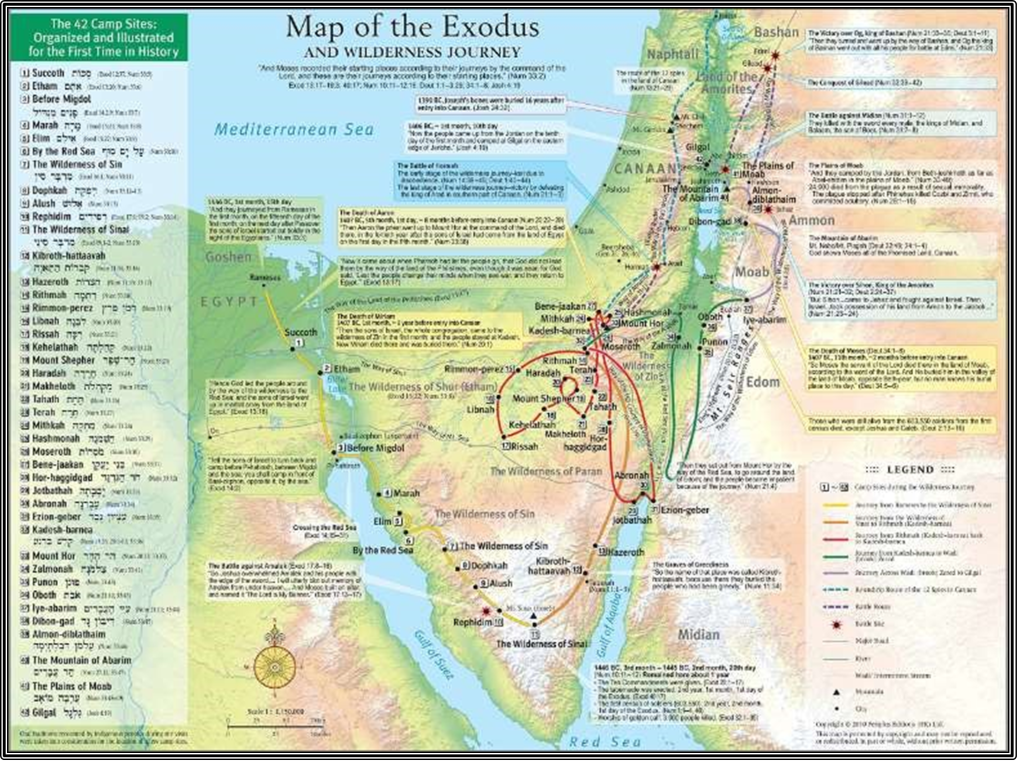
Appendix I Detail Map of the Wilderness Journey
Appendix J Jewish Feasts instituted by God
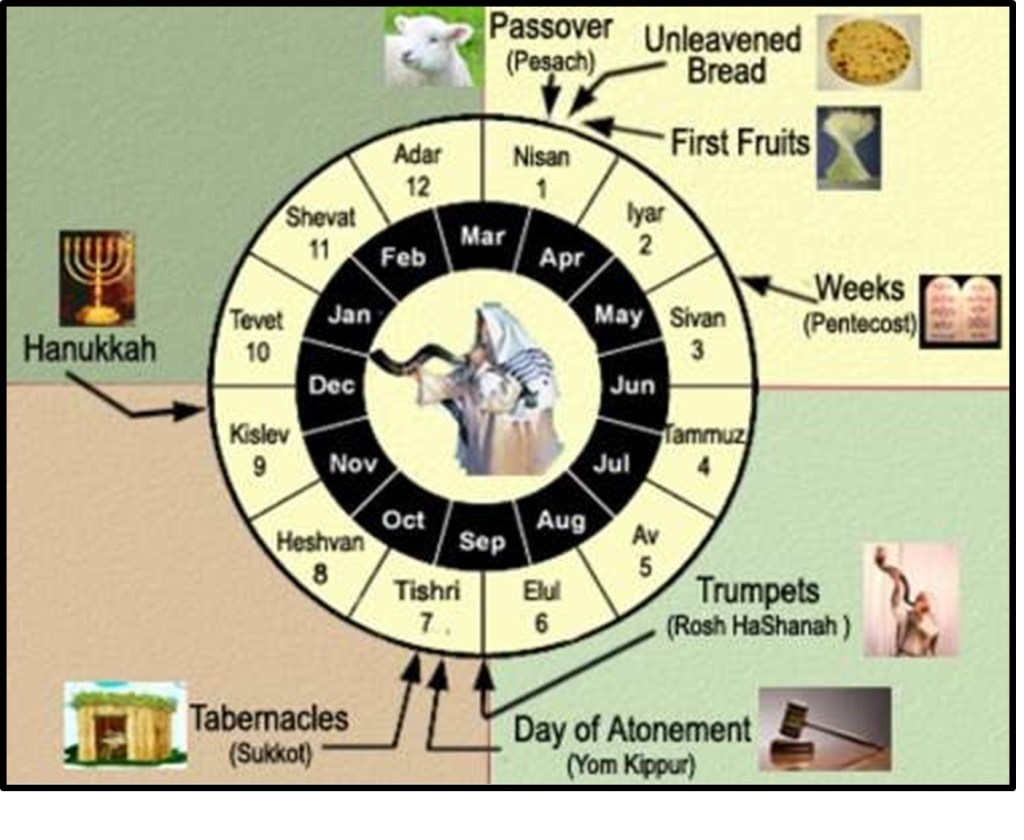
The Sabbath: The Word “Sabbath” comes from the Hebrew Shabbat… To cease, to end, or to rest. It was the only ritual observance instituted in the Ten Commandments and, even in modern Judaism, is considered one of the most important rituals, being a day of not only rest, but of prayer and spiritual enrichment. The Sabbath was (and is) observed every week from sundown on Friday to sundown on Saturday, and had a two-fold significance. It was both a remembrance of creation, inasmuch as the Israelites were to imitate God’s example and rest on the seventh day, as the Lord rested on the seventh day of creation.
So, the sons of Israel shall observe the Sabbath, to celebrate the Sabbath throughout their generations as a perpetual covenant.’ “It is a sign between Me and the sons of Israel forever; for in six days the Lord made heaven and earth, but on the seventh day He ceased from labor, and was refreshed.” (Exodus 31:16-17 NASB)
It was also a remembrance of the nation’s deliverance from the bondage of Egypt. Deuteronomy 5:15 “’You shall remember that you were a slave in the land of Egypt, and the LORD your God brought you out of there by a mighty hand and by an outstretched arm; therefore, the LORD your God commanded you to observe the Sabbath day. (NASB)
In addition, remembering that they were once slaves in Egypt, they were to rest themselves and allow their bondservants to rest (Exodus 20:10, both of which were radical concepts in ancient times. No work was done, nor did anyone fast on the Sabbath, since it was considered a day of joy. Meals, cooked the day previous, were often more elaborate and eaten more leisurely.
High Sabbaths There were seven annualor High Sabbath days, which did not necessarily fall on the weekly Sabbath, but were related to the annual feast days as listed in Leviticus 23. Neither the Passover nor the Feast of First Fruits were High Sabbath days, but the first and last days of the seven-day Feast of Unleavened Bread, and the seven-day Feast of Tabernacles were both High Sabbaths.
The Passover and Unleavened bread: Passover are perhaps the most important of Jewish festivals in the Old Testament. The origins of Passover in Exodus 12-15 are well known from Charlton Heston’s The Ten Commandments, though the Old Testament text unfortunately is not often as widely read. In Exodus 12, the LORD first gives the instructions for the Passover festival. Passover occurs in the first month of the Jewish religious calendar, the month of Nisan, corresponding to March, April, or sometimes May on our calendar. On the evening before the fifteenth day of the month, Israelites were to sacrifice a lamb and place its blood above their doorposts as a sign that the angel of judgment passed over them when they were in Egypt, sparing their lives. After the Egyptians had received judgment, they admonished Israel to leave immediately. In preparation for this exodus, the people were to make bread without leaven, for it had no time to rise. They were to eat their meal in haste knowing that the following day would be the day of their deliverance. As a memorial, the Feast of Unleavened bread continued to be practiced throughout the Old Testament times and beyond, a memorial of God’s redemptive acts for His people.
Although Exodus 12 has the most detailed instructions for Passover, additional (rather, repeated) instructions also appear in Leviticus 23, Numbers 9, Deuteronomy 16, and— eschatologically—in Ezek 45. In pre-exilic times, the festival is observed in by Joshua in Joshua 5, by Josiah in 2 Kings 23 and 2 Chronicles 35, and by Hezekiah in 2 Chronicles 30. Ezra 6 also records a post-exilic celebration of Passover by the returnees from exile. Perhaps the most widely known reference to the Passover in the Bible by Christians relates to Jesus being crucified during Passover week in the Gospels (Mark 14-15, Matt. 26-27, Luke 22-23, John 18-19). The synoptic Gospels seem primarily interested in historical accuracy, placing Jesus’ death on the day before Passover, while the Gospel of John—more theologically oriented—places Jesus crucifixion on the day of Passover. It appears John is less interested in relaying the precise historical date and is more interested in likening Jesus to the Passover lamb sacrificed for the redemption of God’s people.
The Feast of Firstfruits: And the Lord spoke to Moses, saying, “Speak to the children of Israel, and say to them: ‘When you come into the land which I give to you, and reap its harvest, then you shall bring a sheaf of the first fruits of your harvest to the priest. He shall wave the sheaf before the Lord, to be accepted on your behalf; on the day after the Sabbath, the priest shall wave it. In addition, you shall offer on that day, when you wave the sheaf, a male lamb of the first year, without blemish, as a burnt offering to the Lord. Its grain offering shall be two-tenths of an ephah of fine flour mixed with oil, an offering made by fire to the Lord, for a sweet aroma; and its drink offering shall be of wine, one-fourth of a hin. You shall eat neither bread nor parched grain nor fresh grain until the same day that you have brought an offering to your God; it shall be a statute forever throughout your generations in all your dwellings. [Leviticus 23:9-14]
The Feast of First fruits, on the 17th day of Nisan, was a celebration of the harvest, when a sheaf representing the very first of the harvest was waved before the Lord, as a symbolic gesture that dedicated the coming harvest to Him. (This sheaf was likely to be barley, which was the first crop to ripen).
However there some controversy as to the timing of this event. The Scriptures say the wave offering was made “on the day after the Sabbath”. Orthodox Judaism taking the position that it is the day following the “High Sabbath”, which was the first day of the seven-day feast of Unleavened Bread. Others believe that it was the day after the regular Sabbath that fell during the seven-day feast.
Adding to the problem is that we are not sure exactly which year Jesus was crucified, various scholars having come up with different dates, usually ranging from 30 to 33 AD. However, since Jesus was crucified on the exact day of the Passover, we can be sure He rose on the festival of First Fruits. Remembering that the Jews counted their days from sundown to sundown… the likely scenario was that Jesus was crucified on Wednesday, and rose three days later after nightfall on Saturday evening when the regular Saturday Sabbath was over and the festival of First-fruits had begun… “On the day after the Sabbath”.
Jesus rose from the dead on the Feast of First fruits. His resurrection was as a wave offering presented to the Father as the first fruits of the harvest to come at the end of the age. The Apostle Paul said…”But now is Christ risen from the dead and become the first fruits of them that slept. “…”For as in Adam all die, even so in Christ shall all be made alive. But every man in his own order, Christ the first fruits, afterward they that are Christ’s at his coming.” [1 Corinthians 15:20, 23].
The Feast of Weeks: In the same way that the Feast of Unleavened Bread celebrates the origination of the Exodus, the Feast of Weeks—also known as the Feast of Ingathering (Exod. 34:22)—celebrates the culmination of the Exodus at Mount Sinai. The Feast of Weeks occurs seven weeks and one day following Passover, thus the Greek term Pentecost, meaning “the 50th (day),” following the historical account in Exodus 19:1-3 of Israel’s arrival at Sinai fifty days after the Passover. The Feast of Weeks included giving grain offerings to God and included a “holy convocation” (Num. 28:26, NASB), and a day of rest (Num. 28:26, NASB). The phrase “holy convocation” perhaps could better be rendered “a convocation of holiness,” i.e. a “declaration of holiness” or “call to holiness,” reminiscent of the assembly at the foot of Sinai wherein God called His people to be a kingdom of priests and a holy nation (Exod. 19:3-6). During the festival, grain offerings were given as freewill offerings to God in gratitude for redeeming His people and calling them to holiness (Exod. 34:22; Deut. 16:10, 16).
God’s spirit descended upon Sinai at Pentecost in Exodus 19, offering Israel prevenient grace in the form of the Law and a call to holiness. In the same way, the Holy Spirit was sent upon the Church at Pentecost in Acts 2, offering the apostles and all who would follow prevenient grace enabling us to respond to His call to holiness.
The Feast of Trumpets (Rosh Hashanah): Then the Lord spoke to Moses, saying, “Speak to the children of Israel, saying: ‘In the seventh month, on the first day of the month, you shall have a Sabbath-rest, a memorial of blowing of trumpets, a holy convocation. You shall do no customary work on it; and you shall offer an offering made by fire to the Lord.’ “[Leviticus 23:23-25]
Rosh Hashanah literally means, “Head of the year” and is commonly known as the Jewish New Year. It is observed on the first day of Tishri, the seventh month of the Hebrew calendar (September-October) and is now largely celebrated for two days, although the observance of a second day is a later addition.
Like Yom Kippur after it, Rosh Hashanah was not linked to the remembrance of any historical event. While traditional Judaism believes that, on Rosh Hashanah, the destiny of all mankind is recorded by God in the Book of Life, the Bible has not expressly specified what this feast represents, simply stating, “that it was a High Sabbath on which they were to blow the shofar and do no work.” Even the “Blowing of Trumpets”couldliterally mean shouting, an acclamation of joy or a battle cry.
Some believe that this feast day looked forward to the fall of Jericho, when the walls fell at the blowing of the trumpets on the seventh day; therefore, both events serve as a type of the Rapture since Paul said we would be raised at the “last trumpet”. However, all the feasts until now have symbolized a sequence of events in chronological order. Jesus’ Crucifixion (Passover), the removal of sin (Unleavened Bread), The Resurrection (First fruits), Pentecost (the Festival of Weeks). Therefore, it is unlikely that Rosh Hashanah will be fulfilled by the Rapture, which is not the next event scheduled to take place on the End Time calendar. Note the following….
The first day of every month was begun with the blowing of trumpets, but there was deeper significance attached tothe blowing of trumpets on the first day of the seventh month. Rosh Hashanah heralded the beginning of the period known as the High Holy Days with The Day of Atonement (Yom Kippur) occurring ten days later, on the tenth of the month. The ten days from Rosh Hashanah to the Day of Atonement, (both inclusive) are known as “the days of awe”, a time of national repentance for Israel. It was a time of penitence, prayer, and fasting, in preparation for the Feast of Tabernacles. This period was very different from the times of communal celebrations of events (such as Passover and Purim).
However, what really catches the attention is the fact that the Ten Days of Penitence are seen as an opportunity for change, a person’s fate being suspended until Yom Kippur, after which there was no turning back. “If they do well, they are inscribed in the book of life. If not, in the book of death”.
I strongly suspect that these Days of Awe are symbolic of the final days of the age during which repentance is yet possible… when mankind (and the church) will be given their last opportunity to repent before the tenth day, which will be Yom Kippur or the Day of Atonement. While the significance of the number of days is not known, there is a pertinent story in 1 Samuel that typifies the final ten days.
When David and his men were on the run from King Saul, they asked from help from a “very great”, and obviously rich man called Naval, who is described as “churlish and evil” and a “worthless fellow”. In the past Naval had received protection from David’s men, but refuses to help David, who then leads four hundred men to war on Naval. A potential disaster is averted by Abigail, Navel’s wife who was not only beautiful, but “of good understanding”. She, unknown to her husband, packed large amounts of food on asses and took it to David’s camp where she asked David to spare her household, which he did. However, when Abigail returns home, she finds Naval very drunk and holding a feast in his house. Therefore, she says nothing until the next day when she tells him that she has made amends. Instead of admitting his error and repenting, Naval hardens his heart… Scripture telling us “his heart died within him, and he became as a stone”. Ten days later God strikes him and he dies.
This is the story of a man who was given the opportunity to be a part of the coming kingdom of Israel under David; a type of the kingdom of God under Jesus. He refuses the offer and, although he does not know it, has ten days to change his mind and repent, which he does not do, with the result that he is slain at the end of the ten-day period. This is likely to be a foreshadowing of those people who, in the end times, will refuse to turn from their sin and seek God.
The Day of Atonement (Yom Kippur): And the Lord spoke to Moses, saying, “Also the tenth day of this seventh month shall be the Day of Atonement. It shall be a holy convocation for you; you shall afflict your souls, and offer an offering made by fire to the Lord. In addition, you shall do no work on that same day, for it is the Day of Atonement, to make atonement for you before the Lord your God. For any person who is not afflicted in soul on that same day shall be cut off from his people. In addition, any person who does any work on that same day, that person I will destroy from among his people. You shall do no manner of work; it shall be a statute forever throughout your generations in all your dwellings. It shall be to you a Sabbath of solemn rest, and you shall afflict your souls; on the ninth day of the month at evening, from evening to evening, you shall celebrate your Sabbath.” [Leviticus 23:26-32]
Yom Kippur, the Day of Atonement, occurs on the 10th day of Tishri or the seventh month. It is the final day of the Ten Days of Repentance, which began with Rosh Hashanah. According to the sixteenth chapter of Leviticus, Yom Kippur was as day of a solemn fast, on which no food or drink could be consumed, and on which all work was forbidden. The solemnity of the occasion is highlighted by the fact that God said that anyone who did not “afflict his soul” on that day would be cut off from the community.
Unlike other Holy Days, the Feast of Trumpets (Rosh Hashanah), and the Day of Atonement (Yom Kippur), were not linked to remembrance of historical events, but were strictly a time for people to make a thorough assessment of their lives. God’s grace was the underlying principle of the scapegoat and the Atonement itself. It was a time to verify if the sins which had been confessed and atoned for during the previous year, had also been forsaken. If not, God provided a last opportunity.
The Day of Atonement represented the conclusion of the very important and somber period that began ten days earlier on Rosh Hashanah or the Feast of Trumpets. These ten days were called The Days of Awe because life and death were uncertain, the Jews believing that the destiny of each person was decided by the heavenly court in this period. On the Day of Atonement, the people prepared themselves, with fasting and prayer, to stand trial before the heavenly court that would review their life of the past year, and render a verdict.
Rabbi Irving Greenberg writes that on Yom Kippur “the ritual trial reaches its conclusion. Jews experience what a death sentence would mean by living as if dead for a day, giving up the fundamentals of dignified life. . . The people finally drop all their defenses and excuses and throw themselves on the mercy of the court, yet the same people never lose the conviction that they will be pardoned. This atonement is by divine grace; it is above and beyond the individual effort or merit.”
Many, if not most, Christians see Yom Kippur or the Day of Atonement as a foreshadowing of the coming of Jesus, and His final sacrifice for our sin on Calvary. However, this interpretation does not make any sense, as it does not square with the consecutive sequence of the feasts. The Death and Resurrection of Jesus were already symbolized by Passover and First fruits, and the feasts have moved on through Pentecost.
Therefore, to see Yom Kippur as going back several steps to Calvary is either because most people have no other explanation, or are trying to tie in the Feasts with preconceived ideas. The fact remains that the Feasts are in perfect chronological order; therefore, Yom Kippur has to represent a day that follows Rosh Hashanah and the Ten Days of Awe. As discussed above, the symbolism of Rosh Hashanah, or the Feast of Trumpets, seems glaringly obvious. The Days of Awe, or the Seven Trumpets of God’s Wrath, being the last and final opportunity, anyone will get to repent before the doors finally close.
Then comes Yom Kippur, the symbolism of which is found in the book of Hebrews and the book of Revelation… passages that too many Christians have simply skimmed over.
Hebrews:
The author of Hebrews both compared and contrasted the prescribed ritual of the atonement as carried out by the High Priest in Old Testament times, with Christ’s redeeming sacrifice on the cross. He tells us how the imperfect observances on Yom Kippur (the Day of Atonement) are but a type, or a shadow of the perfect to come.
In the Old Testament, the high priest could not go behind the veil into the Most Holy Place of the temple but, on this day, he entered into the presence of God, in the Holy of Holies, to atone for the sins of the nation. He slaughtered both a bull as a sin offering for himself, and a goat as a sin offering for the people, brought the blood of each into the veil, and sprinkled it on, and in front of, the Mercy Seat. This ritual, which took place every year, pointed to a future event that had yet to occur. Jesus as our High Priest did not need to repeat the sacrifice but once, offering His own blood as a one-time sacrifice for sin.
Again, remembering that the details of this ceremony were laid out by God, and a type of an event yet to take place, we turn to the ultimate sacrifice made by Jesus on Calvary. Just as the blood of the goat was shed, Jesus shed His blood for the atonement of sin YES! However, Jesus’ blood has (in a sense) to be sprinkled on the Mercy Seat, which is when the atonement is complete. We know that Jesus shed His blood on Calvary, but when does (or did) the second part of the process actually happen. Hebrews 9:24-26 gives us a glimpse into the full symbolism of Yom Kippur.
For Christ entered not into a holy place made with hands, like in pattern to the true; but into heaven itself. He is now to appear before the face of God for us: nor yet that he should offer himself often. As the high priest entered into the holy place year by year with blood not his own; else must he often have suffered since the foundation of the world: but now once at the end of the ages hath he been manifested to put away sin by the sacrifice of himself.
“Has been” is the perfect tense, which, in English, indicates the past. However, in the original Hebrew and Greek, the perfect tense is often used when the speaker intends to represent a future action as if it were already accomplished. The past tense is used to emphasize the certainty of a future event. However, in the vast majority of the cases, the translators have not literally translated the tense, but have changed it into the future tense, which is understandable, as it would only confuse most Christians. In this case, the timing of the event is very specific… at the consummation of the ages.
The Feast of Tabernacles: Then the Lord spoke to Moses, saying, “Speak to the children of
Israel, ‘The fifteenth day of this seventh month shall be the Feast of Tabernacles for seven days to the Lord. On the first day, there shall be a holy convocation. You shall do no customary work on it. For seven days, you shall offer an offering made by fire to the Lord. On the eighth day, you shall have a holy convocation, and you shall offer an offering made by fire to the Lord. It is a sacred assembly, and you shall do no customary work on it. These are the feasts of the Lord, which you shall proclaim to be holy convocations, to offer an offering made by fire to the Lord, a burnt offering and a grain offering. A sacrifice and drink offerings, everything on its day– besides the Sabbaths of the Lord, besides your gifts, besides all your vows, and besides all your freewill offerings which you give to the Lord. ‘Also on the fifteenth day of the seventh month, when you have gathered in the fruit of the land, you shall keep the feast of the Lord for seven days; on the first day there shall be a Sabbath-rest, and on the eighth day a Sabbath rest. In addition, you shall take for yourselves on the first day the fruit of beautiful trees, branches of palm trees, the boughs of leafy trees, and willows of the brook; and you shall rejoice before the Lord your God for seven days. You shall keep it as a feast to the Lord for seven days in the year. It shall be a statute forever in your generations. You shall celebrate it in the seventh month. You shall dwell in booths for seven days. All who are native Israelites shall dwell in booths, that your generations may know that I made the children of Israel dwell in booths when I brought them out of the land of Egypt: I am the Lord your God.’ “[Leviticus 23:33-43]
The seventh and final Feast is the Feast of Tabernacles, which was also known as the Feast of Ingathering (Exodus 23:16; 34:22), and the Feast of Booths. It started five days after the Day of Atonement on the fifteenth of Tishri (October), and extended for seven days. The first and last days of the Feast were days of “solemn rest”.
On the first day of the feast, each participant had to collect branches of wild olive, myrtle, willow, and palm trees for construction of their booth (Nehemiah 8:13-18), in which they lived in for the next seven days. It was a time of great rejoicing for all, and thou shalt rejoice in thy feast, thou, and thy son, and thy daughter, and thy man-servant, and thy maid-servant, and the Levite, and the sojourner, and the fatherless, and the widow, that are within thy gates. [Deuteronomy 16:14]
The Feast of Tabernacles looks forward to the Kingdom of the Messiah. Revelation 7:9-17 describes a great multitude, who have come through the tribulation, as arrayed in white robes with palms in their hands.
Note: “Tabernacle” may not be the best translation of the Hebrew word sukkah (plural: sukkot) because the word “tabernacle” in the Bible refers to the portable Sanctuary in the desert, a precursor to the Temple (mishkan), while sukkot refers to the temporary booths that people lived in during their 40 year wanderings.
The two most important ceremonies of the Feast of Tabernacles— pouring out of water drawn from the pool of Siloam, and the illumination of the Temple were both of post-Mosaic origin and referred back to the water and the “pillar of light” provided during the wilderness wandering, when people dwelt in temporary shelters.
It is in connection with the Feast of Tabernacles that the gospel of John records a fascinating event. John wrote: “In the last day (eighth day), that great day of the feast, Jesus stood and cried out, saying, If any man thirst, let him come unto me, and drink. He that believeth on me, as the scripture hath said, out of his heart shall flow rivers of living water” (John 7:37-38). The Son of God was saying in the clearest possible way that He alone was the source of life and blessing; that He could meet every need of the human heart.
- Matthew Henry’s Commentary – Volume I (page 70) ii Matthew Henry’s Commentary – Volume I (page 97)
- Hebrew and Chaldee Dictionary
Appendix K Detail Map of the Wilderness Journey
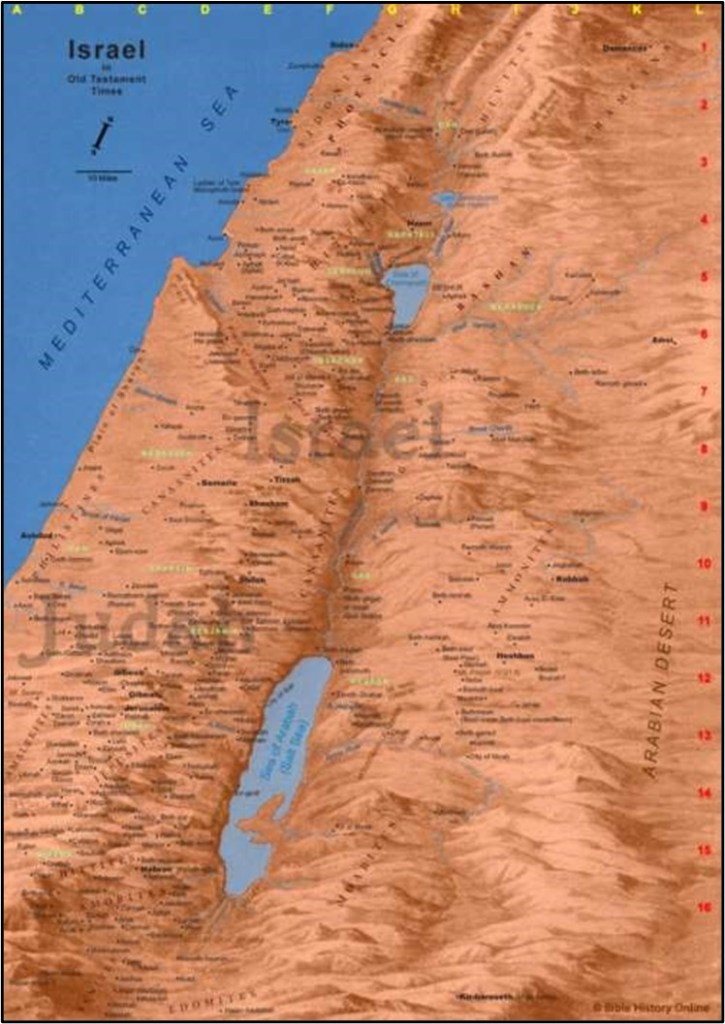
Map 1
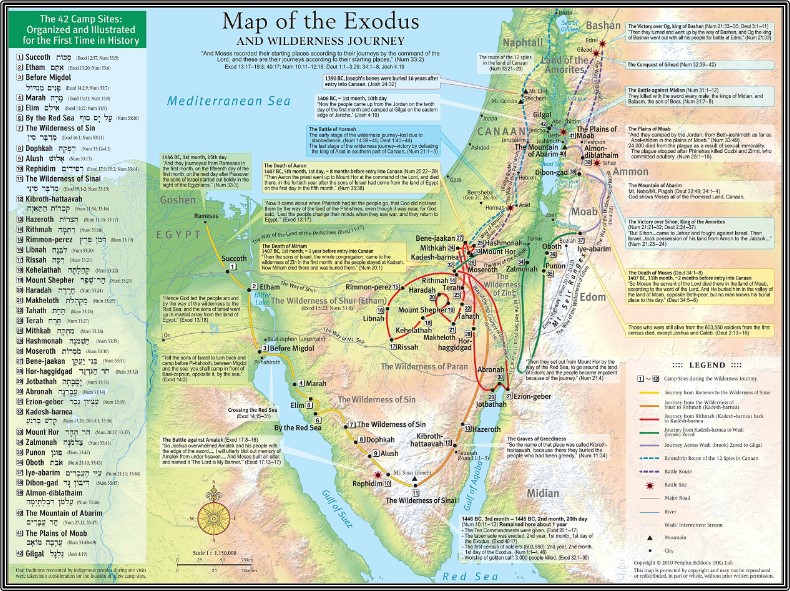
Map 2 Wilderness map with indexes
Appendix L Jewish Feasts instituted by God
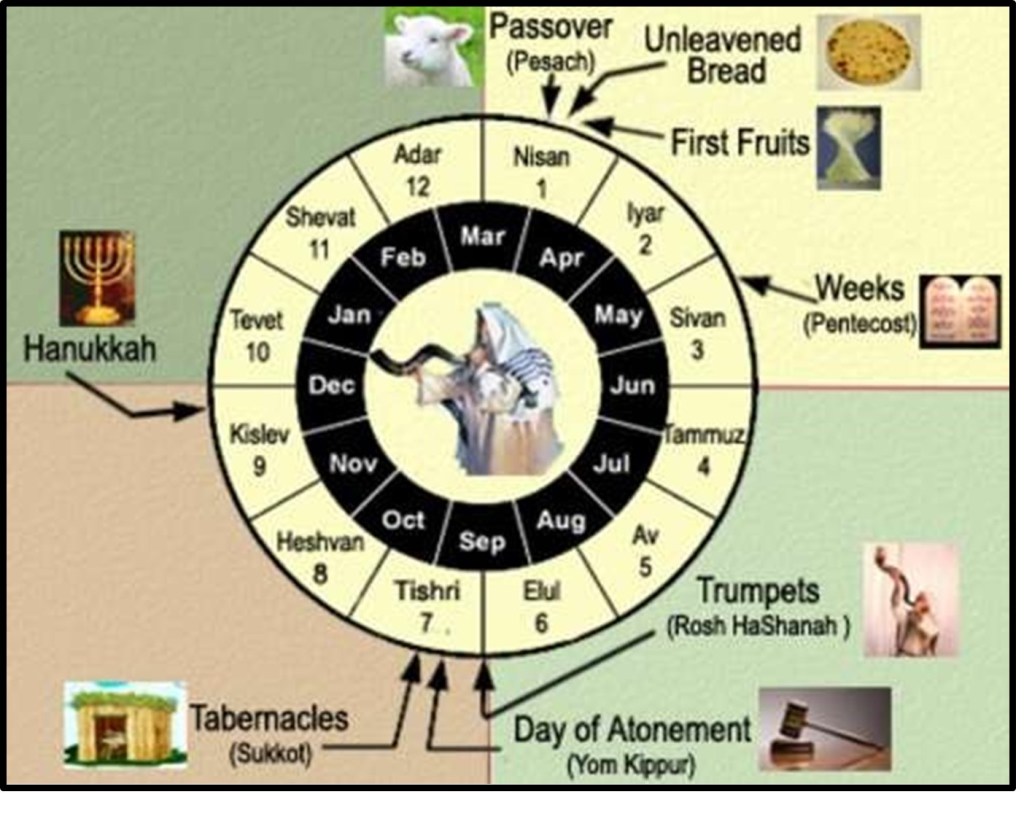
The Sabbath: The Word “Sabbath” comes from the Hebrew Shabbat… To cease, to end, or to rest. It was the only ritual observance instituted in the Ten Commandments and, even in modern Judaism, is considered one of the most important rituals, being a day of not only rest, but of prayer and spiritual enrichment. The Sabbath was (and is) observed every week from sundown on Friday to sundown on Saturday, and had a two-fold significance. It was both a remembrance of creation, inasmuch as the Israelites were to imitate God’s example and rest on the seventh day, as the Lord rested on the seventh day of creation.
So, the sons of Israel shall observe the Sabbath, to celebrate the Sabbath throughout their generations as a perpetual covenant.’ “It is a sign between Me and the sons of Israel forever; for in six days the Lord made heaven and earth, but on the seventh day He ceased from labor, and was refreshed.” (Exodus 31:16-17 NASB)
It was also a remembrance of the nation’s deliverance from the bondage of Egypt. Deuteronomy 5:15 “’You shall remember that you were a slave in the land of Egypt, and the LORD your God brought you out of there by a mighty hand and by an outstretched arm; therefore, the LORD your God commanded you to observe the Sabbath day. (NASB)
In addition, remembering that they were once slaves in Egypt, they were to rest themselves and allow their bondservants to rest (Exodus 20:10, both of which were radical concepts in ancient times. No work was done, nor did anyone fast on the Sabbath, since it was considered a day of joy. Meals, cooked the day previous, were often more elaborate and eaten more leisurely.
High Sabbaths There were seven annualor High Sabbath days, which did not necessarily fall on the weekly Sabbath, but were related to the annual feast days as listed in Leviticus 23. Neither the Passover nor the Feast of First Fruits were High Sabbath days, but the first and last days of the seven-day Feast of Unleavened Bread, and the seven-day Feast of Tabernacles were both High Sabbaths.
The Passover and Unleavened bread: Passover is perhaps the most important of Jewish festivals in the Old Testament. The origins of Passover in Exodus 12-15 are well known from Charlton Heston’s The Ten Commandments, though the Old Testament text unfortunately is not often as widely read. In Exodus 12, the LORD first gives the instructions for the Passover festival. Passover occurs in the first month of the Jewish religious calendar, the month of Nisan, corresponding to March, April, or sometimes May on our calendar. On the evening before the fifteenth day of the month, Israelites were to sacrifice a lamb and place its blood above their doorposts as a sign that the angel of judgment passed over them when they were in Egypt, sparing their lives. After the Egyptians had received judgment, they admonished Israel to leave immediately. In preparation for this exodus, the people were to make bread without leaven, for it had no time to rise. They were to eat their meal in haste knowing that the following day would be the day of their deliverance. As a memorial, the Feast of Unleavened bread continued to be practiced throughout the Old Testament times and beyond, a memorial of God’s redemptive acts for His people.
Although Exodus 12 has the most detailed instructions for Passover, additional (rather, repeated) instructions also appear in Leviticus 23, Numbers 9, Deuteronomy 16, and—eschatologically—in Ezek 45. In pre-exilic times, the festival is observed in by Joshua in Joshua 5, by Josiah in 2 Kings 23 and 2 Chronicles 35, and by Hezekiah in 2 Chronicles 30. Ezra 6 also records a post-exilic celebration of Passover by the returnees from exile. Perhaps the most widely known reference to the Passover in the Bible by Christians relates to Jesus being crucified during Passover week in the Gospels (Mark 14-15, Matt. 26-27, Luke 22-23, John 18-19). The synoptic Gospels seem primarily interested in historical accuracy, placing Jesus’ death on the day before Passover, while the Gospel of John—more theologically oriented—places Jesus crucifixion on the day of Passover. It appears John is less interested in relaying the precise historical date and is more interested in likening Jesus to the Passover lamb sacrificed for the redemption of God’s people.
| <img width="76" height="31" src="" alt="Text Box: “> |
The Feast of Firstfruits: And the Lord spoke to Moses, saying, “Speak to the children of Israel, and say to them: ‘When you come into the land which I give to you, and reap its harvest, then you shall bring a sheaf of the first fruits of your harvest to the priest. He shall wave the sheaf before the Lord, to be accepted on your behalf; on the day after the Sabbath, the priest shall wave it. In addition, you shall offer on that day, when you wave the sheaf, a male lamb of the first year, without blemish, as a burnt offering to the Lord. Its grain offering shall be two-tenths of an ephah of fine flour mixed with oil, an offering made by fire to the Lord, for a sweet aroma; and its drink offering shall be of wine, one-fourth of a hin. You shall eat neither bread nor parched grain nor fresh grain until the same day that you have brought an offering to your God; it shall be a statute forever throughout your generations in all your dwellings. [Leviticus 23:9-14]
The Feast of First fruits, on the 17th day of Nisan, was a celebration of the harvest, when a sheaf representing the very first of the harvest was waved before the Lord, as a symbolic gesture that dedicated the coming harvest to Him. (This sheaf was likely to be barley, which was the first crop to ripen).
However there some controversy as to the timing of this event. The Scriptures say the wave offering was made “on the day after the Sabbath”. Orthodox Judaism taking the position that it is the day following the “High Sabbath”, which was the first day of the seven-day feast of Unleavened Bread. Others believe that it was the day after the regular Sabbath that fell during the seven-day feast.
Adding to the problem is that we are not sure exactly which year Jesus was crucified, various scholars having come up with different dates, usually ranging from 30 to 33 AD. However, since Jesus was crucified on the exact day of the Passover, we can be sure He rose on the festival of First Fruits. Remembering that the Jews counted their days from sundown to sundown… the likely scenario was that Jesus was crucified on Wednesday, and rose three days later after nightfall on Saturday evening when the regular Saturday Sabbath was over and the festival of First-fruits had begun… “On the day after the Sabbath”.
Jesus rose from the dead on the Feast of First fruits. His resurrection was as a wave offering presented to the Father as the first fruits of the harvest to come at the end of the age. The Apostle Paul said…”But now is Christ risen from the dead and become the first fruits of them that slept. “…”For as in Adam all die, even so in Christ shall all be made alive. But every man in his own order, Christ the first fruits, afterward they that are Christ’s at his coming.” [1 Corinthians 15:20, 23]. [Return]
The Feast of Weeks: In the same way that the Feast of Unleavened Bread celebrates the origination of the Exodus, the Feast of Weeks—also known as the Feast of Ingathering (Exod. 34:22)—celebrates the culmination of the Exodus at Mount Sinai. The Feast of Weeks occurs seven weeks and one day following Passover, thus the Greek term Pentecost, meaning “the 50th (day),” following the historical account in Exodus 19:1-3 of Israel’s arrival at Sinai fifty days after the Passover. The Feast of Weeks included giving grain offerings to God and included a “holy convocation” (Num. 28:26, NASB), and a day of rest (Num. 28:26, NASB). The phrase “holy convocation” perhaps could better be rendered “a convocation of holiness,” i.e. a “declaration of holiness” or “call to holiness,” reminiscent of the assembly at the foot of Sinai wherein God called His people to be a kingdom of priests and a holy nation (Exod. 19:3-6). During the festival, grain offerings were given as freewill offerings to God in gratitude for redeeming His people and calling them to holiness (Exod. 34:22; Deut. 16:10, 16).
God’s spirit descended upon Sinai at Pentecost in Exodus 19, offering Israel prevenient grace in the form of the Law and a call to holiness. In the same way, the Holy Spirit was sent upon the Church at Pentecost in Acts 2, offering the apostles and all who would follow prevenient grace enabling us to respond to His call to holiness. [Return]
The Feast of Trumpets (Rosh Hashanah): Then the Lord spoke to Moses, saying, “Speak to the children of Israel, saying: ‘In the seventh month, on the first day of the month, you shall have a Sabbath-rest, a memorial of blowing of trumpets, a holy convocation. You shall do no customary work on it; and you shall offer an offering made by fire to the Lord.’ “[Leviticus 23:23-25]
- Rosh Hashanah literally means, “Head of the year” and is commonly known as the Jewish New Year. It is observed on the first day of Tishri, the seventh month of the Hebrew calendar (September-October) and is now largely celebrated for two days, although the observance of a second day is a later addition.
Like Yom Kippur after it, Rosh Hashanah was not linked to the remembrance of any historical event. While traditional Judaism believes that, on Rosh Hashanah, the destiny of all mankind is recorded by God in the Book of Life, the Bible has not expressly specified what this feast represents, simply stating, “that it was a High Sabbath on which they were to blow the shofar and do no work.” Even the “Blowing of Trumpets”couldliterally mean shouting, an acclamation of joy or a battle cry.
Some believe that this feast day looked forward to the fall of Jericho, when the walls fell at the blowing of the trumpets on the seventh day; therefore, both events serve as a type of the Rapture since Paul said we would be raised at the “last trumpet”. However, all the feasts until now have symbolized a sequence of events in chronological order. Jesus’ Crucifixion (Passover), the removal of sin (Unleavened Bread), The Resurrection (First fruits), Pentecost (the Festival of Weeks). Therefore, it is unlikely that Rosh Hashanah will be fulfilled by the Rapture, which is not the next event scheduled to take place on the End Time calendar. Note the following….
The first day of every month was begun with the blowing of trumpets, but there was deeper significance attached tothe blowing of trumpets on the first day of the seventh month. Rosh Hashanah heralded the beginning of the period known as the High Holy Days with The Day of Atonement (Yom Kippur) occurring ten days later, on the tenth of the month. The ten days from Rosh Hashanah to the Day of Atonement, (both inclusive) are known as “the days of awe”, a time of national repentance for Israel. It was a time of penitence, prayer, and fasting, in preparation for the Feast of Tabernacles. This period was very different from the times of communal celebrations of events (such as Passover and Purim).
However, what really catches the attention is the fact that the Ten Days of Penitence are seen as an opportunity for change, a person’s fate being suspended until Yom Kippur, after which there was no turning back. “If they do well, they are inscribed in the book of life. If not, in the book of death”.
I strongly suspect that these Days of Awe are symbolic of the final days of the age during which repentance is yet possible… when mankind (and the church) will be given their last opportunity to repent before the tenth day, which will be Yom Kippur or the Day of Atonement. While the significance of the number of days is not known, there is a pertinent story in 1 Samuel that typifies the final ten days.
When David and his men were on the run from King Saul, they asked from help from a “very great”, and obviously rich man called Naval, who is described as “churlish and evil” and a “worthless fellow”. In the past Naval had received protection from David’s men, but refuses to help David, who then leads four hundred men to war on Naval. A potential disaster is averted by Abigail, Naval’s wife who was not only beautiful, but “of good understanding”. She, unknown to her husband, packed large amounts of food on asses and took it to David’s camp where she asked David to spare her household, which he did. However, when Abigail returns home, she finds Naval very drunk and holding a feast in his house. Therefore, she says nothing until the next day when she tells him that she has made amends. Instead of admitting his error and repenting, Naval hardens his heart… Scripture telling us “his heart died within him, and he became as a stone”. Ten days later God strikes him and he dies.
This is the story of a man who was given the opportunity to be a part of the coming kingdom of Israel under David; a type of the kingdom of God under Jesus. He refuses the offer and, although he does not know it, has ten days to change his mind and repent, which he does not do, with the result that he is slain at the end of the ten-day period. This is likely to be a foreshadowing of those people who, in the end times, will refuse to turn from their sin and seek God.
The Day of Atonement (Yom Kippur): And the Lord spoke to Moses, saying, “Also the tenth day of this seventh month shall be the Day of Atonement. It shall be a holy convocation for you; you shall afflict your souls, and offer an offering made by fire to the Lord. In addition, you shall do no work on that same day, for it is the Day of Atonement, to make atonement for you before the Lord your God. For any person who is not afflicted in soul on that same day shall be cut off from his people. In addition, any person who does any work on that same day, that person I will destroy from among his people. You shall do no manner of work; it shall be a statute forever throughout your generations in all your dwellings. It shall be to you a Sabbath of solemn rest, and you shall afflict your souls; on the ninth day of the month at evening, from evening to evening, you shall celebrate your Sabbath.” [Leviticus 23:26-32]
Yom Kippur, the Day of Atonement, occurs on the 10th day of Tishri or the seventh month. It is the final day of the Ten Days of Repentance, which began with Rosh Hashanah. According to the sixteenth chapter of Leviticus, Yom Kippur was as day of a solemn fast, on which no food or drink could be consumed, and on which all work was forbidden. The solemnity of the occasion is highlighted by the fact that God said that anyone who did not “afflict his soul” on that day would be cut off from the community.
Unlike other Holy Days, the Feast of Trumpets (Rosh Hashanah), and the Day of Atonement (Yom Kippur), were not linked to remembrance of historical events, but were strictly a time for people to make a thorough assessment of their lives. God’s grace was the underlying principle of the scapegoat and the Atonement itself. It was a time to verify if the sins which had been confessed and atoned for during the previous year, had also been forsaken. If not, God provided a last opportunity.
The Day of Atonement represented the conclusion of the very important and somber period that began ten days earlier on Rosh Hashanah or the Feast of Trumpets. These ten days were called The Days of Awe because life and death were uncertain, the Jews believing that the destiny of each person was decided by the heavenly court in this period. On the Day of Atonement, the people prepared themselves, with fasting and prayer, to stand trial before the heavenly court that would review their life of the past year, and render a verdict.
Rabbi Irving Greenberg writes that on Yom Kippur “the ritual trial reaches its conclusion. Jews experience what a death sentence would mean by living as if dead for a day, giving up the fundamentals of dignified life. . . The people finally drop all their defenses and excuses and throw themselves on the mercy of the court, yet the same people never lose the conviction that they will be pardoned. This atonement is by divine grace; it is above and beyond the individual effort or merit.”
Many, if not most, Christians see Yom Kippur or the Day of Atonement as a foreshadowing of the coming of Jesus, and His final sacrifice for our sin on Calvary. However, this interpretation does not make any sense, as it does not square with the consecutive sequence of the feasts. The Death and Resurrection of Jesus were already symbolized by Passover and First fruits, and the feasts have moved on through Pentecost.
Therefore, to see Yom Kippur as going back several steps to Calvary is either because most people have no other explanation, or are trying to tie in the Feasts with preconceived ideas. The fact remains that the Feasts are in perfect chronological order; therefore, Yom Kippur has to represent a day that follows Rosh Hashanah and the Ten Days of Awe. As discussed above, the symbolism of Rosh Hashanah, or the Feast of Trumpets, seems glaringly obvious. The Days of Awe, or the Seven Trumpets of God’s Wrath, being the last and final opportunity, anyone will get to repent before the doors finally close.
Then comes Yom Kippur, the symbolism of which is found in the book of Hebrews and the book of Revelation… passages that too many Christians have simply skimmed over.
Hebrews:
The author of Hebrews both compared and contrasted the prescribed ritual of the atonement as carried out by the High Priest in Old Testament times, with Christ’s redeeming sacrifice on the cross. He tells us how the imperfect observances on Yom Kippur (the Day of Atonement) are but a type, or a shadow of the perfect to come.
In the Old Testament, the high priest could not go behind the veil into the Most Holy Place of the temple but, on this day, he entered into the presence of God, in the Holy of Holies, to atone for the sins of the nation. He slaughtered both a bull as a sin offering for himself, and a goat as a sin offering for the people, brought the blood of each into the veil, and sprinkled it on, and in front of, the Mercy Seat. This ritual, which took place every year, pointed to a future event that had yet to occur. Jesus as our High Priest did not need to repeat the sacrifice but once, offering His own blood as a one-time sacrifice for sin.
Again, remembering that the details of this ceremony were laid out by God, and a type of an event yet to take place, we turn to the ultimate sacrifice made by Jesus on Calvary. Just as the blood of the goat was shed, Jesus shed His blood for the atonement of sin YES! However, Jesus’ blood has (in a sense) to be sprinkled on the Mercy Seat, which is when the atonement is complete. We know that Jesus shed His blood on Calvary, but when does (or did) the second part of the process actually happen. Hebrews 9:24-26 gives us a glimpse into the full symbolism of Yom Kippur.
For Christ entered not into a holy place made with hands, like in pattern to the true; but into heaven itself. He is now to appear before the face of God for us: nor yet that he should offer himself often. As the high priest entered into the holy place year by year with blood not his own; else must he often have suffered since the foundation of the world: but now once at the end of the ages hath he been manifested to put away sin by the sacrifice of himself.
“Has been” is the perfect tense, which, in English, indicates the past. However, in the original Hebrew and Greek, the perfect tense is often used when the speaker intends to represent a future action as if it were already accomplished. The past tense is used to emphasize the certainty of a future event. However, in the vast majority of the cases, the translators have not literally translated the tense, but have changed it into the future tense, which is understandable, as it would only confuse most Christians. In this case, the timing of the event is very specific… at the consummation of the ages.
The Feast of Tabernacles: Then the Lord spoke to Moses, saying, “Speak to the children of Israel, ‘The fifteenth day of this seventh month shall be the Feast of Tabernacles for seven days to the Lord. On the first day, there shall be a holy convocation. You shall do no customary work on it. For seven days, you shall offer an offering made by fire to the Lord. On the eighth day, you shall have a holy convocation, and you shall offer an offering made by fire to the Lord. It is a sacred assembly, and you shall do no customary work on it. These are the feasts of the Lord, which you shall proclaim to be holy convocations, to offer an offering made by fire to the Lord, a burnt offering and a grain offering. A sacrifice and drink offerings, everything on its day– besides the Sabbaths of the Lord, besides your gifts, besides all your vows, and besides all your freewill offerings which you give to the Lord. ‘Also, on the fifteenth day of the seventh month, when you have gathered in the fruit of the land, you shall keep the feast of the Lord for seven days; on the first day there shall be a Sabbath-rest, and on the eighth day a Sabbath-rest. In addition, you shall take for yourselves on the first day the fruit of beautiful trees, branches of palm trees, the boughs of leafy trees, and willows of the brook; and you shall rejoice before the Lord your God for seven days. You shall keep it as a feast to the Lord for seven days in the year. It shall be a statute forever in your generations. You shall celebrate it in the seventh month. You shall dwell in booths for seven days. All who are native Israelites shall dwell in booths, that your generations may know that I made the children of Israel dwell in booths when I brought them out of the land of Egypt: I am the Lord your God.’ “[Leviticus 23:33-43]
The seventh and final Feast is the Feast of Tabernacles, which was also known as the Feast of Ingathering (Exodus 23:16; 34:22), and the Feast of Booths. It started five days after the Day of Atonement on the fifteenth of Tishri (October), and extended for seven days. The first and last days of the Feast were days of “solemn rest”.
On the first day of the feast, each participant had to collect branches of wild olive, myrtle, willow, and palm trees for construction of their booth (Nehemiah 8:13-18), in which they lived in for the next seven days. It was a time of great rejoicing for all, and thou shalt rejoice in thy feast, thou, and thy son, and thy daughter, and thy man-servant, and thy maid-servant, and the Levite, and the sojourner, and the fatherless, and the widow, that are within thy gates. [Deuteronomy 16:14]
The Feast of Tabernacles looks forward to the Kingdom of the Messiah… Revelation 7:9-17 describes a great multitude, who have come through the tribulation, as arrayed in white robes with palms in their hands. [Return]
Note: “Tabernacle” may not be the best translation of the Hebrew word sukkah (plural: sukkot) because the word “tabernacle” in the Bible refers to the portable Sanctuary in the desert, a precursor to the Temple (mishkan), while sukkot refers to the temporary booths that people lived in during their 40 year wanderings.
The two most important ceremonies of the Feast of Tabernacles— pouring out of water drawn from the pool of Siloam, and the illumination of the Temple were both of post-Mosaic origin and referred back to the water and the “pillar of light” provided during the wilderness wandering, when people dwelt in temporary shelters.
It is in connection with the Feast of Tabernacles that the gospel of John records a fascinating event. John wrote: “In the last day (eighth day), that great day of the feast, Jesus stood and cried out, saying, if any man thirst, let him come unto me, and drink. He that believeth on me, as the scripture hath said, out of his heart shall flow rivers of living water” (John 7:37-38). The Son of God was saying in the clearest possible way that He alone was the source of life and blessing; that He could meet every need of the human heart.
[1] Moshe Tzvi Segal, “Ha-shemot Ya`akov—Yisrael be-Sefer Bereshit,” Mesoret u-Vikoret ha-Mikra, Jerusalem 1957.
[2] “The name Israel appears instead of Jacob wherever Joseph and his brother Benjamin are concerned,” Abraham Geiger, Ha-Mikra veTargumav: Be-Zikah le-Hitpathutah ha-Pnimit shel ha-Yahadut, 1948, p. 239.
[3] “The general rule is that wherever the name designates the father of the nation, there the name Israel is used…giving preference to or elevating Joseph or Benjamin over the other tribes. Elsewhere the name Jacob is used.” Cited in Segal (note 1, above), p. 69. 50 Ibid. p. 75.
[4] See other discussions by Rabbi Samson Raphael Hirsh of the names by which Jacob is called: Gen. 45:27-28, 48:8.
[5] Counting every single appearance of the word “Jacob” and the word “Israel”, as Segal did, yields 47 occurrences of the name Jacob as opposed to 29 of the name Israel, beginning with chapter 35:10. Segal, however, also included all the appearances of these names, including those in Jacob’s blessing to his sons and in expressions such as “children of Israel” and “tribes of Israel,” even though these occurrences do not reflect what was Jacob himself was undergoing.
[6] See II Sam. 13:18.
[7] Rashi, on verse 49:24, cites the Midrash about Potiphar’s wife, which describes Joseph’s partial failing.
[8] See Gen. 43:6, 8, and 11.
[9] Indeed, Rabbi Samson Raphael Hirsch sees this moment as one of recovering strength: “As long as Jacob was plagued by doubts and believed that he must not let Benjamin go, his name appears as Jacob, but once he realized the utter necessity—Benjamin’s life was in danger whether he stayed home or went with them—then he pulls himself up and becomes Israel” (commentary on 43:6).
[10] Nahmanides raises the issue of Joseph’s disavowal of his father being a moral problem: “One wonders how it was that, after being long in Egypt and a clerk and overseer in an important Egyptian official’s house, Joseph did not write to his father to inform him of his presence and console him; for Egypt is only six days’ travel from Hebron, and had it been even a year’s journey away, he should still have contacted him out of filial respect” (commentary on verse 42:9). * Thanks to Dr. Meir Roth for his helpful comments.
 Grow in the Word of the Lord